In the academic world, peer review serves as the primary benchmark for scientific validation and quality assurance. Before an empirical paper, systematic survey, or theoretical framework is officially published, it undergoes rigorous critique by independent subject matter specialists.
Whether you are preparing your initial manuscript or evaluating prospective journals, understanding the mechanics of peer review demystifies editorial expectations, accelerates publication timelines, and helps you respond constructively to reviewer criticism.
1. What Is Peer Review in Scholarly Publishing?
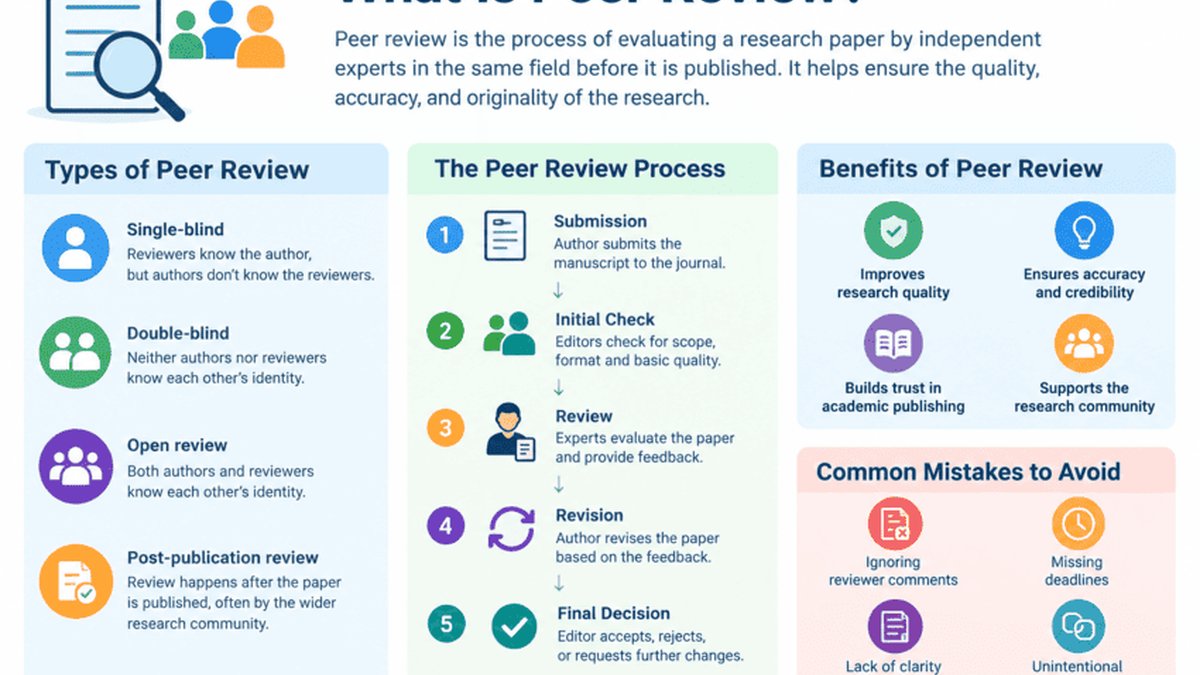
At its core, peer review is an expert assessment system where research papers are formally evaluated by independent scholars working within the same or complementary fields.
Peer review serves three vital functions:
- Quality Filtering: It weeds out flawed methodology, invalid statistical interpretations, and unsubstantiated conclusions before they reach the scientific community.
- Constructive Refinement: Expert reviewers offer actionable recommendations to strengthen clarity, contextual literature, and reproducibility.
- Trust and Integrity: It signals to academic institutions, granting agencies, and indexers that the published research meets established scholarly standards.
2. The Four Primary Types of Peer Review
Different academic journals utilize different peer review architectures to manage bias, maintain impartiality, and promote transparency.
| Review Model | How It Works | Primary Advantage | Potential Limitation |
|---|---|---|---|
| Single-Blind Review | Reviewers know author identities; authors do not know reviewers. | Reviewers can critique frankly without fear of career friction. | Potential for institutional, regional, or prestige bias against newer authors. |
| Double-Blind Review (Standard) | Neither authors nor reviewers know each other's identities. | Highest level of impartiality; judges the work solely on merit. | Complete anonymization can be challenging in hyper-specialized subfields. |
| Open Peer Review | Both identities are disclosed; reviewer reports are often published. | Complete transparency, reduced conflicts of interest, and professional courtesy. | Junior scholars may hesitate to offer critical feedback on senior investigators' work. |
| Post-Publication Review | The paper is published after initial checks; public commentary follows. | Fast dissemination; dynamic community scrutiny over time. | Requires active ongoing moderation to filter out low-value opinions. |
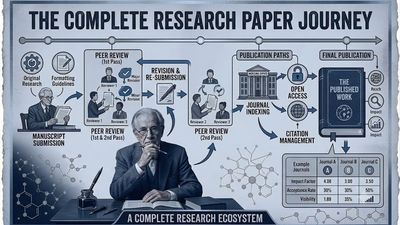
3. Peer Review Workflow Pipeline
-
Manuscript Submission
- Author submits original manuscript, cover letter, and datasets.
-
Desk Screening & Editorial Triage
- Checked for journal scope, initial rigor, and similarity/plagiarism standards.
- ❌ If out-of-scope or major flaws: Immediate Desk Rejection
- ✅ If approved: Moves forward to domain review.
-
Expert Peer Review
- Assigned to 2–3 independent domain specialists.
- Evaluated on methodology validity, data reproducibility, and scholarly contribution.
-
Editorial Decision & Next Steps
- 🏆 Accept Without Revision (Rare — < 5% of submissions)
- 🔄 Minor or Major Revisions Requested (Most common path)
- 🚫 Reject or Transfer/Redirect to a more suitable specialized journal
-
Rebuttal and Final Sign-Off
- Author submits an itemized point-by-point response matrix alongside the tracked revised manuscript before final production and DOI assignment.
4. Key Benefits of the Peer Review System
Engaging in the peer review process provides significant advantages for researchers and the scientific record:
- Elevates Manuscript Quality: Reviewers routinely spot overlooked edge cases, missing benchmark comparisons, or unclear data visualizations.
- Guards Against Misinformation: Robust evaluation acts as a protective bulwark against manipulated figures, pseudo-science, and AI-hallucinated citations.
- Expands Citation Potential: Papers that survive rigorous peer scrutiny are viewed with greater authority by fellow scholars, leading to sustained indexing and citation growth.
- Fosters Academic Growth: Formulating professional responses to pointed technical critiques sharpens an author’s critical communication skills.
5. Common Mistakes Authors Make (and How to Avoid Them)
Navigating peer review successfully requires avoiding these frequent traps:
Mistake 1: Taking Reviewer Critique Personally
Reviewers dissect the written manuscript, not the author's worth. Even sharp, direct feedback often points to sections where your explanation was ambiguous. Approach comments with objective curiosity.
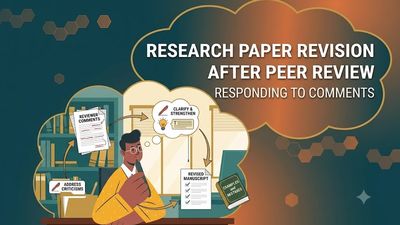
Mistake 2: Vague or Dismissive Rebuttal Letters
Writing "Fixed" or "Done" in response to an in-depth comment frustrates editors. Use a structured response matrix containing three clear columns:
- The exact reviewer comment
- Your detailed explanation of how it was addressed
- The exact line/page numbers showing the revised text
Mistake 3: Incomplete Anonymization in Double-Blind Submissions
Leaving your name in self-citations (e.g., "As we proved in our previous 2024 study..."), institutional email footers, or file metadata compromises the double-blind process and causes administrative delays.
Mistake 4: Overlooking Minor Editorial Comments
Authors frequently address the big technical hurdles but ignore secondary suggestions like typo corrections or figure resolution updates. Address every single comment, no matter how small.
Summary
Peer review is not an adversarial barrier designed to block your path; it is an academic crucible designed to refine and validate your contribution. By understanding review expectations, embracing constructive feedback, and submitting well-organized revisions, you substantially elevate your publishing trajectory.
Related Perspectives in Education & Library Sciences