
Peer Review Process & Editorial Workflow
FJMRI upholds the highest standards of scholarly integrity through an objective, double-blind peer review system. Every manuscript is thoroughly evaluated by independent domain experts to ensure methodological rigor, original contribution, and reproducibility.
Our editorial team completes desk pre-screening and renders the Initial Editorial Decision within 2 business days (Steps 1–4). Following rigorous double-blind peer review, the Peer Review Decision is typically delivered within 7 to 14 days (Steps 5–8), with Publication & Zenodo DOI allocation completed in 1 to 2 business days post-payment.
End-to-End Scholarly Pipeline
The 10-Stage Peer Review & Publishing Roadmap
From initial submission through desk pre-screening, double-blind peer review, author proofing, and persistent Zenodo DOI publication.
Visual Peer Review & Publishing Workflow
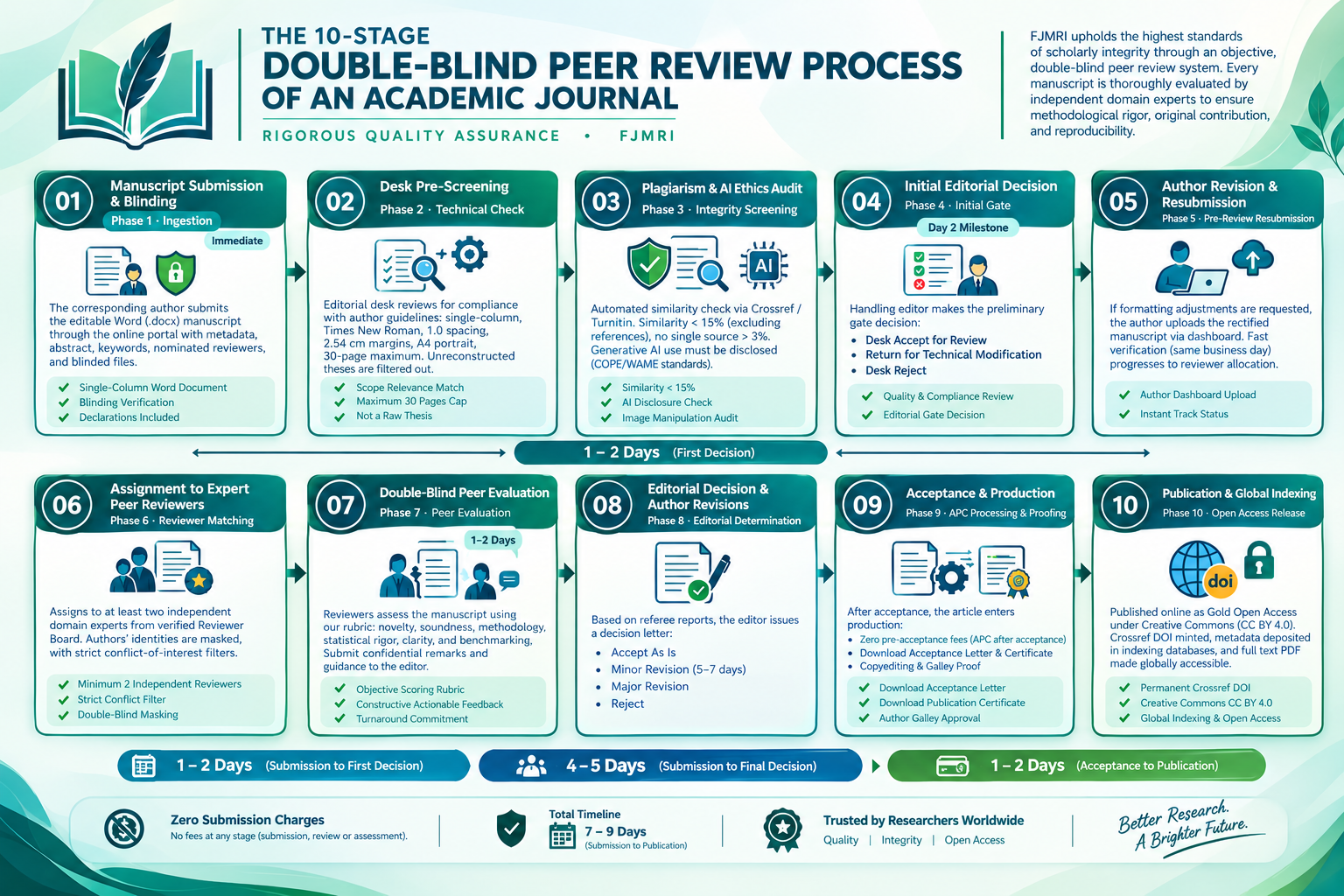
Sequential infographic mapping all 10 milestones from author submission to open-access Zenodo DOI publication.
Manuscript Submission & Blinding
The corresponding author submits the editable Microsoft Word (.docx) manuscript through the online submission portal. The submission includes metadata, abstract, keywords, nominated non-conflicted reviewers, and blinded files ensuring author identities are removed from the body text.
Desk Pre-Screening
The editorial desk reviews the manuscript for compliance with core author guidelines: single-column formatting, Times New Roman typography, 1.0 spacing, normal 2.54 cm margins, A4 portrait orientation, and the 30-page maximum ceiling. Unreconstructed theses are filtered out at this stage.
Plagiarism & AI Ethics Audit
Every submission undergoes automated similarity indexing and originality screening. Submissions must exhibit an overall similarity score below 15% (excluding references) with no single source exceeding 3%. Usage of generative AI tools must be transparently disclosed in the methodology in compliance with COPE/WAME standards.
Initial Editorial Decision (Day 1–2)
Having audited both Desk Pre-Screening (author guideline compliance: single-column formatting, Times New Roman typography, 1.0 spacing, normal 2.54 cm margins, A4 portrait orientation, 30-page ceiling, no raw theses) and Plagiarism & AI Ethics (<15% similarity), the handling editor delivers the Initial Editorial Decision within 1 to 2 business days:
- Desk Accept for Peer Review: The manuscript satisfies all technical criteria and is passed immediately to expert reviewer matching.
- Technical Modification / Resubmission: Minor formatting deviations (e.g. margin adjustments, missing citations) returned to author for same-day correction.
- Desk Reject: Submissions clearly out of scope, exceeding 30 pages, exhibiting excessive plagiarism (>15%), or submitted as raw theses are rejected immediately without wasting author time.
Author Revision & Resubmission (If Needed)
If the handling editor requested formatting adjustments during desk pre-screening, the author uploads the rectified manuscript via their dashboard. Upon fast verification (same business day), the paper progresses to reviewer allocation.
Assignment to Expert Peer Reviewers
The manuscript is assigned to at least two independent domain experts from our verified Reviewer Board matching the paper's specific subcategory. Authors' identities and institutions are masked, and strict conflict-of-interest filters ensure reviewers have no institutional or co-authorship ties with the authors.
Double-Blind Peer Evaluation
Independent doctoral reviewers assess the manuscript against our standardized rubric: scientific novelty, theoretical soundness, experimental methodology, statistical rigor, clarity of presentation, and literature benchmarking. Reviewers submit detailed confidential remarks to the editor alongside constructive guidance for the authors.
Peer Review Decision (Steps 5–8)
Synthesizing the independent referee reports from 2+ domain reviewers, the handling editor delivers the official Peer Review Decision typically within 7 to 14 days of reviewer assignment:
Manuscript meets all standards and moves directly into production.
Author given 5–7 days to clarify minor points or update citations.
Substantial experiments or theoretical refinement needed before second review round.
Fundamental methodological flaws, fatal lack of novelty, or unresolvable gaps.
Formal Acceptance & Transparent APC (Zero Pre-Acceptance Charges)
Upon peer-reviewed formal acceptance, the handling editor issues the official acceptance notice. No charges are ever required during submission or review. Payment is strictly requested only after formal acceptance:
- Zero Submission Charges: Free submission, desk screening, and double-blind review. Authors pay the transparent Article Processing Charge (APC) strictly after formal acceptance.
- Instant Document Generation: Authors can immediately download their signed Acceptance Letter and Author Publication Certificate directly from their dashboard.
- Galley Proof Production: Production typesets the article into final camera-ready layout with author approval within 24 hours.
Publication, Zenodo DOI & Discovery (1–2 Days)
Following payment confirmation and author galley proof approval, final online publication and repository deposition take just 1 to 2 business days:
- Zenodo DOI Allocation: Permanent, active DOI registered via Zenodo / DataCite and linked to the version of record.
- Gold Open Access CC BY 4.0: Immediate, perpetual worldwide access with zero subscription paywalls.
- Metadata & Discovery Ingestion: Highwire Press and Dublin Core tags automatically enabled for Google Scholar and search engines within 1–2 days.
Fair & Unbiased Evaluation
Double-Blind Peer Review Protocol
Protecting objective scholarship by ensuring complete mutual anonymity.
Author Blinding Obligations
Authors must prepare manuscripts to prevent accidental identification:
- Omit author names, institutional affiliations, and email addresses from the title page and body text.
- Refer to own prior work neutrally in the third person (e.g. "Smith et al. previously showed..." rather than "We previously showed...").
- Remove author names and institution metadata from Microsoft Word document file properties.
- Omit specific funding grant references and acknowledgments from the review copy (these are re-inserted upon acceptance).
Reviewer & Editorial Commitments
Editors and reviewers strictly adhere to confidentiality:
- Reviewers evaluate papers strictly based on scientific content without knowing author gender, nationality, or seniority.
- Review reports remain strictly anonymous to the authors throughout and after the review process.
- Manuscripts are confidential documents; reviewers may not share, copy, or use the research prior to publication.
- Reviewers must immediately recuse themselves if they identify a potential conflict of interest.
Standardized Assessment
Reviewer Evaluation Scoring Rubric
Our independent referees evaluate every manuscript across five fundamental scholarly pillars.
Originality & Novelty
Does the research articulate a clear problem gap and contribute novel theoretical models, empirical findings, or interdisciplinary methodologies?
Methodological Rigor
Are experimental procedures, datasets, mathematical formulations, and algorithmic architectures clearly explained and reproducible by peers?
Data & Statistical Validity
Are empirical results backed by rigorous statistical tests (p-values, confidence intervals, error bars, effect sizes) without over-extrapolation?
Literature Grounding
Does the paper adequately contextualize its contributions within contemporary literature and cite active DOIs in APA 7th format?
Clarity & Formatting
Is the manuscript written with high clarity in English, adhering to the single-column Times New Roman format within the 30-page limit?
Appeals, Disputes & Editorial Re-Evaluation
Authors have the right to appeal an editorial rejection if they believe a decision was influenced by a factual error or significant reviewer misunderstanding.
Submit Written Appeal
Email the editorial office within 14 days with point-by-point rebuttal addressing factual inaccuracies in the review report.
Independent Editorial Scrutiny
The Editor-in-Chief and an independent member of the Advisory Board examine the original reports and author rebuttal.
Final Determination
The Editor-in-Chief decides whether to invite a third independent review or uphold the decision. The appeal outcome is final.
Ready to Publish?
Submit Your Manuscript to FJMRI Today
Experience rapid 1–2 day desk screening, constructive 4–5 day double-blind peer review, and global open-access reach.