
Author Guidelines & Manuscript Preparation
Complete step-by-step instructions for preparing, formatting, and submitting manuscripts to Frontier Journal of Multidisciplinary Research and Innovation (FJMRI).
Our editorial team completes desk pre-screening and delivers the Initial Editorial Decision within 2 business days. Following double-blind peer review, the Final Editorial Decision is typically delivered within 7 to 14 days.
Submission Roadmap
Step-by-Step Submission Process
Follow these four essential steps to prepare and lodge your manuscript without administrative delay.
Read Guidelines
- Confirm alignment with FJMRI aims and research areas.
- Review authorship, ethical standards, and COPE compliance.
- Ensure research is not a raw thesis or duplicate work.
Prepare Manuscript
- Download and apply the single-column Word template.
- Format in Times New Roman, 1.0 spacing, normal margins.
- Ensure page count does not exceed 30 pages.
Register / Log In
- Access the author submission portal with your credentials.
- Provide verified institutional affiliation and ORCID.
- Confirm all co-author names and institutional emails.
Submit & Track
- Upload your completed editable `.docx` manuscript.
- Nominate suggested peer reviewers without conflicts.
- Track editorial desk screening and review decisions.
Mandatory Requirements
Every submitted manuscript must conform strictly to these core parameters. Submissions deviating from these standards will be immediately returned during desk pre-screening.
Non-Negotiable Submission Criteria
Manuscripts failing any of the following items will not be sent for peer review:
- Raw Thesis / Dissertation Not Accepted: FJMRI strictly rejects unedited academic dissertations or thesis chapters. The content must be independently restructured, condensed, and reframed as a concise scholarly journal paper.
- Maximum 30 Pages Limit: The total length of the manuscript—including title page, abstract, main text, figures, tables, declarations, and references—must not exceed 30 pages.
- Single-Column Format Only: Manuscripts submitted in dual-column or multi-column layouts will be rejected without review.
- One Uniform Header Only: The running header must be identical on every page. Do not include section-specific, chapter, or odd/even page headers.
Typography & Spacing
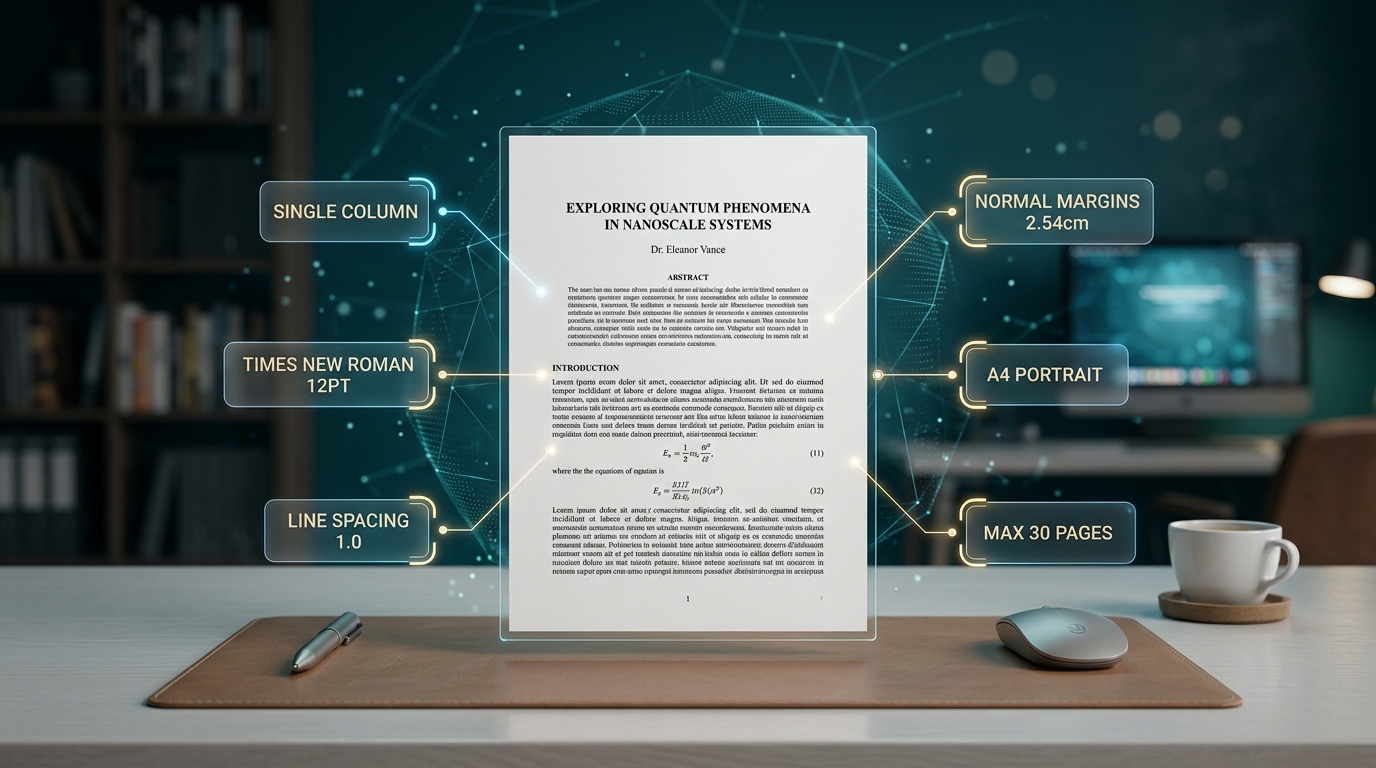
Font family, sizing, and line rules- Font Family: Times New Roman exclusively across the entire document.
- Body Text: 12 pt regular, justified or left-aligned, single line spacing (1.0).
- Section Headings: 14 pt bold for Level 1; 12 pt bold for Level 2 (2.1); 12 pt italic for Level 3 (2.1.1).
- Line Spacing: Strict 1.0 (single) with 0 pt before and 0 pt after paragraph spacing.
Page Setup & Boundaries
Margins, paper size, and page limits- Column Layout: Pure single-column format from first to final page.
- Margins: Normal margins: 1.0 inch (2.54 cm) on Top, Bottom, Left, and Right.
- Paper Size & Orientation: Standard ISO A4 (210 × 297 mm) in Portrait mode only.
- Page Limit: Maximum 30 pages total (including references and appendices).
Header & Running Title
Uniform document identification- 1 Uniform Header: Single running header throughout (FJMRI Running Title). No different first page or odd/even headers.
- Page Numbers: Centered Arabic numerals (1, 2, 3...) in the footer.
- File Format: Editable Microsoft Word (.docx) only. PDFs are not accepted.
Manuscript Preparation & Structure
Manuscripts must follow this sequential 9-part structure as configured in the official author template.
Title Page & Authorship Information
Front Matter- Manuscript Title: Concise, informative sentence-case title (Times New Roman, 16 pt bold, centered).
- Authors & Affiliations: Full author names, departments, institutions, city, and country.
- Corresponding Author: Marked with an asterisk (*) with official institutional email address.
- ORCID IDs: Hyperlinked 16-digit ORCID identifiers for all contributing authors (Register free ORCID iD ↗).
Abstract & Index Keywords
150–250 Words- Abstract Body: 150 to 250 words written as a single unstructured paragraph in the past tense.
- Structure: Must state Background, Research Objective, Methodology, Key Findings, and Primary Conclusion.
- No Citations: Avoid references, footnotes, or undefined acronyms in the abstract.
- Keywords: 4 to 6 specific scholarly terms separated by semicolons (e.g., Artificial Intelligence; Deep Learning; Multi-Agent Systems).
1. Introduction
Context & Aims- Establish the broader problem domain and scientific relevance.
- Provide a focused review of existing contemporary literature.
- Explicitly state the research gap and novel contributions of your work.
2. Materials and Methods
Reproducibility- Provide clear, granular details to enable complete experimental replication.
- Detail datasets, hardware/software tools, mathematical models, and statistical validation.
- Organize logically using numbered decimal subheadings (e.g., 2.1 Dataset Preparation, 2.2 Model Architecture).
3. Results
Findings & Data- Present findings objectively without speculative interpretation.
- Support text with high-resolution figures (300+ dpi) and editable Word tables.
- Include appropriate statistical metrics (p-values, confidence intervals, error bars).
4. Discussion
Critical Analysis- Interpret findings in relation to the original research objectives.
- Compare results directly with benchmark studies cited in the Introduction.
- Address study limitations honestly and discuss theoretical or practical implications.
5. Conclusion
Synthesis- Summarize the primary conclusions and real-world utility of the research.
- Do not duplicate the abstract or rehash results verbatim.
- Recommend promising directions for future research investigations.
Required Ethical & Compliance Declarations
Mandatory StatementsPlace immediately before references. Review our COPE-aligned Publication Ethics & Policies. State "Not applicable" if any category does not apply:
- Funding: Disclose grant numbers and sponsor agencies, or state "No funding received".
- Conflict of Interest: Disclose any commercial or personal relationships.
- Data Availability: Provide repositories or DOI links where datasets and code can be accessed.
- Author Contributions: CRediT roles (conceptualization, data curation, writing).
- Ethical Approval: Institutional Review Board (IRB) approval number for human/animal studies.
References (APA 7th Edition with Active DOIs)
APA 7th · DOIs Mandatory- Follow strict APA 7th edition citation standards.
- Single line spacing with a 0.5-inch hanging indent.
- Active DOIs Required: Every cited reference should feature a valid, clickable DOI (e.g.,
https://doi.org/...) or persistent URL whenever available. Authors can look up missing DOIs using the Crossref Simple Text Query Tool ↗. References missing DOIs may delay editorial verification.
Media Specifications
Figures, Tables & Equations
Follow these formatting rules to ensure high-fidelity publication and rendering.
Figures & Graphics
- Position: Embed directly in the body text immediately following first mention.
- Captions: Placed BELOW the figure (e.g., Figure 1. Architecture of the neural network...).
- Resolution: Minimum 300 dpi for photographs; 600 dpi for diagrams and line charts.
- Color Mode: RGB / CMYK in TIFF, PNG, or high-quality JPEG.
Tables
- Position: Embed directly in the text following first citation.
- Captions: Placed ABOVE the table (e.g., Table 1. Hyperparameter configurations...).
- Format: Must be editable Word tables (never insert tables as raster images).
- Footnotes: Define all column abbreviations and symbols in table footnotes.
Equations
- Tool: Microsoft Word Equation Editor or MathType.
- Numbering: Consecutively numbered in parentheses right-aligned: (1), (2).
- Variables: Italicize scalar variables (x, y); bold vectors/matrices (W, b).
- Explanation: Define all mathematical terms directly below the equation.
Pre-Flight Verification
Submission Quality Checklist
Review each item before submitting to avoid immediate desk screening delays.
1. Layout & Geometry
- Single-column format throughout entire document.
- Times New Roman, 12 pt body, 1.0 single spacing.
- Normal margins: 1.0 inch (2.54 cm) on all 4 sides.
- A4 page size in Portrait orientation.
2. Policy & Limits
- Total page count is 30 pages or fewer.
- Not a raw thesis; reframed into an independent paper.
- Exactly 1 uniform running header across all pages.
- Editable Word (.docx) format file.
3. Scholarly Integrity
- Abstract is 150–250 words; 4–6 keywords included.
- All declarations included before references.
- Strict APA 7th references with active DOIs.
- High-res figures (300+ dpi) and editable tables.
Clear Solutions
Frequently Asked Questions & Step Answers
Essential answers formatted in step boxes to resolve common author inquiries quickly.
Can I submit a master's or doctoral thesis directly?
No. FJMRI does not accept raw theses or dissertations.
- Thesis content must be condensed into a self-contained research paper.
- Reframe literature reviews from exhaustive chapters to targeted gap analysis.
- Limit total document length to the 30-page maximum.
How long does editorial screening and peer review take?
Our editorial team completes desk pre-screening and issues the Initial Editorial Decision within 2 business days. The complete double-blind peer review concludes with the Final Editorial Decision typically within 7 to 14 days.
- Initial Editorial Decision (Within 2 Business Days): Formatting compliance, 30-page ceiling, raw thesis filtering, and plagiarism screening.
- Final Editorial Decision (Typically 7–14 Days): Evaluated by at least 2 independent external reviewers with a definitive acceptance, revision, or rejection decision.
- Live Tracking: Real-time status visible via your author dashboard.
Can I use a two-column format or other fonts?
No. All submissions must strictly be single-column in Times New Roman.
- Use Times New Roman font exclusively throughout the paper.
- Line spacing must be exactly 1.0 (single) with normal 2.54 cm margins.
- Two-column or non-standard fonts will be rejected at pre-screening.
Can my manuscript exceed the 30-page limit?
No. The maximum limit is strictly 30 pages.
- The 30-page ceiling includes all text, figures, tables, declarations, and references.
- Papers exceeding 30 pages will be automatically flagged and returned.
- Extensive raw data or additional code should be uploaded to public repositories (Zenodo/GitHub) and cited in Data Availability.
Are DOIs mandatory for every reference?
Yes. Every cited reference should feature an active DOI or direct URL whenever available.
- Format references strictly according to APA 7th edition.
- Append hyperlinked DOIs:
https://doi.org/10.xxxx/.... - References missing DOIs will be returned during editorial verification.
Can I submit in PDF format, and is there a submission fee?
There are ZERO submission fees. Only editable .DOCX files are accepted.
- Zero Submission Charge: Submitting and peer review are 100% free of charge.
- DOCX Only: PDF files are not accepted for initial submission.
- Word format enables editorial line numbering, blinding, and pre-screening checks.
Ready to Submit?
Submit your manuscript to FJMRI today
Our modern editorial tracking system ensures rapid peer review, clear reviewer comments, and immediate open-access global visibility.