
Introduction
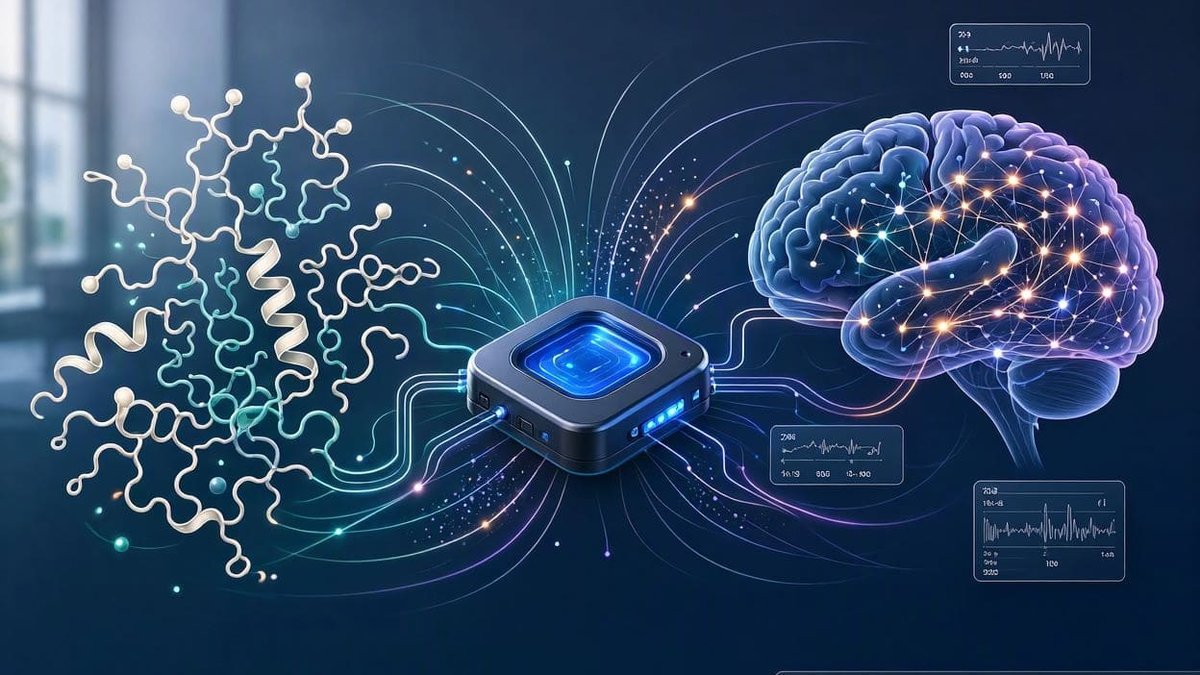
The convergence of quantum physics, biology, and advanced sensing technologies is creating new opportunities to investigate biological processes that are difficult to observe with conventional instruments.
Quantum sensors use physical phenomena such as quantum coherence, spin states, superposition, and quantum transitions to detect extremely small changes in magnetic fields, electric fields, temperature, and other physical quantities.
In biological research, these capabilities can provide new ways to investigate enzyme activity, molecular interactions, cellular processes, and neural signals. The emerging field of quantum biosensing therefore connects fundamental physics with biochemistry, neuroscience, medicine, and biotechnology.
What Are Quantum Sensors?
A quantum sensor uses a controllable quantum system as a measurement device. Instead of relying solely on classical changes in voltage, resistance, or light intensity, quantum sensors can exploit changes in quantum states to detect physical signals.
Several technologies are particularly relevant to biological research:
- Nitrogen-vacancy (NV) centres in diamond
- Atomic magnetometers
- Superconducting quantum interference devices (SQUIDs)
- Quantum optical sensors
- Quantum-enhanced spectroscopy
These systems can be designed to detect weak magnetic or electromagnetic signals generated by biological processes.
The significance is not that quantum sensors “see” biology directly. Rather, they can detect physical signatures associated with biological activity with very high sensitivity.
Why Biology Needs Better Sensors
Many biological processes occur at extremely small spatial and temporal scales.
Enzymes can change molecular structures in fractions of a second. Neurons communicate through electrical and chemical signals. Cellular processes can generate weak electromagnetic fields that are difficult to measure without disturbing the system.
Conventional techniques remain extremely valuable, but researchers often face trade-offs between:
Sensitivity → Spatial resolution → Temporal resolution → Invasiveness
Quantum sensing offers another technological pathway for balancing these requirements.
Quantum Sensors and Enzyme Research
Enzymes accelerate biochemical reactions by lowering activation-energy barriers. Understanding their mechanisms is essential for drug discovery, biotechnology, metabolic research, and synthetic biology.
However, enzyme behaviour involves rapid molecular events that are difficult to observe continuously.
Quantum sensing can potentially contribute by detecting changes in physical properties associated with biochemical reactions.
For example, researchers can investigate:
- Electron-spin changes
- Magnetic signatures
- Reaction intermediates
- Molecular interactions
- Changes in local chemical environments
NV-centre diamond sensors are particularly interesting because their quantum spin states can respond to nearby magnetic fields.
A possible research pathway is:
Biochemical reaction → Physical signal → Quantum sensor → Signal processing → Molecular interpretation
The sensor does not replace biochemical analysis. Instead, it can provide an additional measurement channel.
Understanding Molecular Electron Transfer
Electron transfer is fundamental to many biological processes, including cellular respiration, photosynthesis, and enzyme catalysis.
Because electron movement can involve changes in magnetic and spin-related properties, quantum sensing may provide useful information about these processes.
This is especially relevant when researchers need to study short-lived reaction states that are difficult to capture using conventional measurements.
Combining quantum sensing with spectroscopy, microscopy, and computational modelling could therefore help researchers construct more detailed descriptions of biochemical mechanisms.
Quantum Sensing and Neuroscience
The brain produces electrical and magnetic signals as neurons communicate.
These signals are extremely weak, making sensitive measurement technologies essential.
Quantum sensors are being investigated for applications in magnetoencephalography (MEG) and other forms of neural measurement.
Atomic magnetometers and other quantum-enabled technologies can detect tiny magnetic fields associated with neural activity.
A simplified measurement pathway is:
Neural activity → Electrical current → Magnetic field → Quantum sensor → Neural signal reconstruction
This approach could complement established neuroimaging technologies.
From Conventional MEG to Quantum Magnetometry
Traditional MEG systems often rely on superconducting sensors and require cryogenic cooling.
Newer quantum magnetometers, including optically pumped magnetometers (OPMs), can operate closer to room temperature and may allow more flexible sensor arrangements.
This creates opportunities for:
- Wearable brain imaging
- More flexible sensor placement
- Movement-tolerant measurements
- Naturalistic neuroscience experiments
- High-resolution mapping of neural activity
The technology is still developing, and practical performance depends on factors such as magnetic shielding, sensor sensitivity, interference, and signal-processing methods.
Comparing Quantum and Conventional Biological Sensing
| Feature | Conventional Sensors | Quantum Sensors |
|---|---|---|
| Measurement principle | Classical physical signals | Quantum-state changes |
| Magnetic sensitivity | Varies by technology | Potentially extremely high |
| Biological applications | Broad and established | Emerging and specialised |
| Portability | Often available | Increasing with newer technologies |
| Operating requirements | Technology-dependent | Can range from room temperature to cryogenic |
| Research maturity | Generally mature | Rapidly developing |
Quantum sensors should therefore be viewed as complementary technologies, rather than universal replacements for existing instruments.
The Role of Artificial Intelligence
Quantum sensing generates complex signals that may contain information about biological processes.
Artificial intelligence can assist researchers with:
- Noise reduction
- Signal classification
- Pattern recognition
- Anomaly detection
- Source localisation
- Multimodal data integration
For neuroscience, machine-learning models can potentially help reconstruct neural activity from weak sensor signals.
For biochemistry, computational models can connect measured physical signals with molecular structures or reaction states.
The combination creates a new research pipeline:
Quantum sensing + AI analysis + Biological modelling = Advanced bio-observation
A Multidisciplinary Research Framework
The quantum-bio convergence requires collaboration across several disciplines.
Quantum Physics
Develops sensitive quantum states, measurement techniques, and sensor architectures.
Biochemistry
Interprets molecular reactions, enzyme mechanisms, and biochemical pathways.
Neuroscience
Studies neural signals, brain networks, cognition, and neurological processes.
Engineering
Develops miniaturised sensors, electronics, shielding, and data-acquisition systems.
Computer Science
Provides signal processing, machine learning, simulation, and multimodal analysis.
This interdisciplinary structure is one of the defining characteristics of quantum-enabled biological research.
Key Challenges
Despite its potential, quantum biosensing faces significant technical and scientific challenges.
Environmental Noise
Biological experiments occur in environments containing electromagnetic, thermal, and mechanical noise. Extremely sensitive sensors can detect unwanted signals alongside the biological signal of interest.
Signal Interpretation
Detecting a physical signal does not automatically reveal its biological meaning. Researchers need validated models connecting measurements with molecular or neural processes.
Miniaturisation
For many applications, sensors must become smaller, more robust, and easier to integrate with biological systems.
Reproducibility
Quantum-biosensing experiments require carefully controlled conditions and standardised measurement protocols.
Data Complexity
High-sensitivity measurements can generate large and complex datasets, increasing the need for advanced computational analysis.
Editorial Insight: The major scientific challenge is not simply building a more sensitive sensor. It is establishing a reliable connection between a quantum measurement and a meaningful biological mechanism.
Research Opportunities for PhD Scholars
The field offers several promising interdisciplinary research directions:
- NV-centre sensors for molecular magnetic-field detection
- Quantum magnetometry for neural activity mapping
- AI-based reconstruction of weak biological signals
- Quantum-enhanced spectroscopy for enzyme mechanisms
- Miniaturised wearable neural sensors
- Quantum sensors for cellular and metabolic monitoring
- Multimodal integration of quantum and optical biosensing
- Computational modelling of quantum-biological interactions
Researchers can combine experimental measurements with simulation and machine learning to investigate biological processes at increasingly fine scales.
Future Directions
The next stage of quantum-bio research is likely to focus on integration rather than individual technologies.
Potential systems could combine:
Quantum sensor → Optical imaging → Molecular data → AI analysis → Biological model
Such platforms could provide complementary measurements across different spatial and temporal scales.
In neuroscience, flexible quantum magnetometers may enable researchers to investigate brain activity during more natural behaviours. In biochemistry, highly sensitive measurements may help characterise transient molecular events that are difficult to observe using conventional techniques.
These possibilities remain active research areas rather than established clinical capabilities.
Research Checklist
Researchers entering quantum-bio convergence should consider:
- Define the biological signal before selecting the quantum sensor.
- Quantify environmental noise and measurement limitations.
- Validate quantum measurements against established biological methods.
- Separate detected signals from biological interpretation.
- Use AI as an analysis tool rather than treating predictions as direct measurements.
- Report sensor specifications and experimental conditions clearly.
- Design interdisciplinary collaborations between physicists, biologists, engineers, and computational researchers.
Conclusion
The quantum-bio convergence represents an emerging research frontier where quantum measurement technologies are being adapted to investigate biological systems.
Quantum sensors can provide highly sensitive measurements of magnetic, electrical, and other physical signals associated with molecular and neural activity. Their value lies not only in sensitivity but in opening measurement possibilities that complement established biochemical and neuroscience techniques.
The long-term opportunity is to connect quantum sensing, biological experimentation, artificial intelligence, and computational modelling into integrated research platforms.
For researchers, the central challenge is clear: transform increasingly sensitive quantum measurements into reproducible, interpretable, and biologically meaningful knowledge.