When journal editors, reviewers, and fellow scholars search academic databases, the abstract is almost always the first element they read. Often, it is the only part of your paper that is freely accessible to the public.
A well-crafted abstract acts as a powerful marketing tool for your research, determining whether an editor decides to send your manuscript out for peer review or issue an immediate desk rejection. Despite its brevity (usually between 150 to 250 words), writing a powerful abstract requires precision, discipline, and a clear structural formula.
1. What Is a Research Paper Abstract?
An abstract is a standalone, concise summary of your complete manuscript. It provides a miniature version of your study, allowing readers to grasp the core problem, methodology, findings, and conclusion in under two minutes without reading the full 5,000-word text.
Most reputable journals require structured abstracts divided into specific thematic sub-headings, while others require a single continuous paragraph.
2. The Anatomy of a High-Impact Abstract
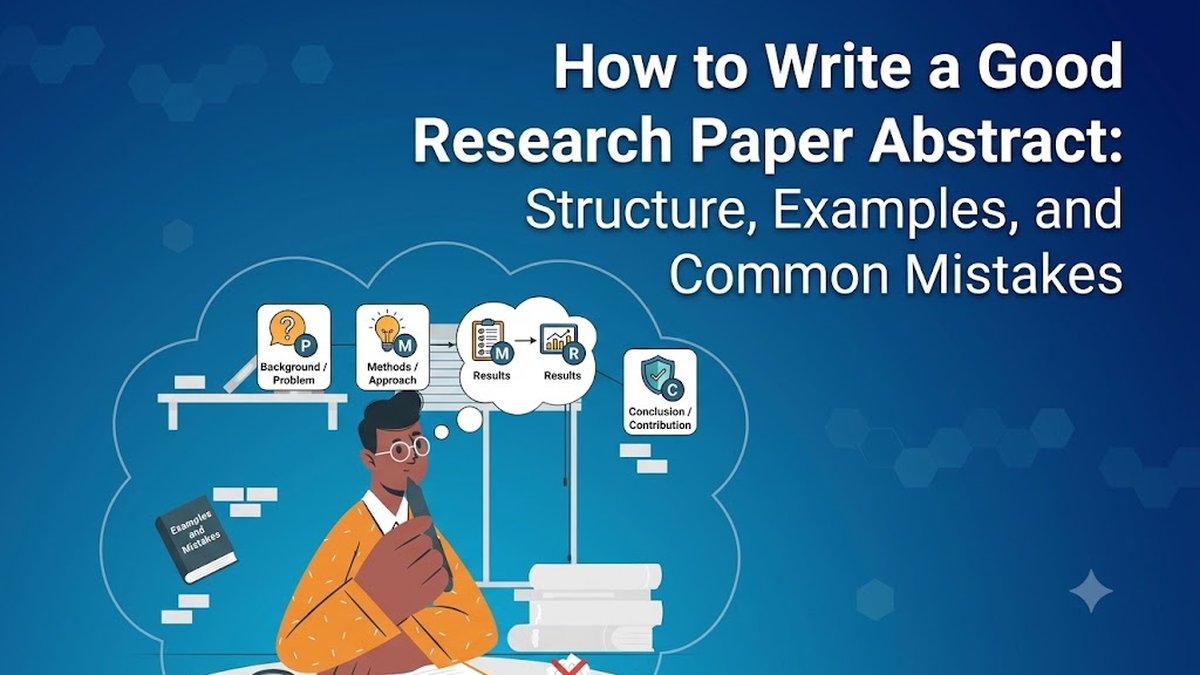
Whether structured or unstructured, a successful research abstract follows a logical 4-part progression:
| Abstract Component | Core Purpose | What to Include |
|---|---|---|
| 1. Background & Objective | Why did you do this study? | State the broader research problem and the specific knowledge gap or hypothesis your study addresses. |
| 2. Materials & Methods | How did you investigate it? | Briefly summarize your study design, dataset size, analytical tools, or experimental framework. |
| 3. Results & Findings | What did you discover? | Highlight 2–3 of your most significant, quantitative data points or qualitative outcomes. |
| 4. Conclusion & Impact | What do the results mean? | State the broader theoretical, practical, or interdisciplinary implications of your work. |
3. Step-by-Step Writing Process
Do not attempt to write your abstract before your paper is finished. Use this workflow instead:
- Draft Last: Write your abstract after your Results and Discussion sections are fully completed so you accurately reflect final data outcomes.
- Extract Core Sentences: Pull one key sentence from each of your main sections: one from the Introduction, one from Methods, two from Results, and one from the Conclusion.
- Refine and Condense: Cut out filler words, introductory pleasantries, and redundant phrases until you hit the journal's strict word limit (typically 200–250 words).
- Remove Citations: Never include external references, bibliographic citations, or definitions of common terms inside an abstract.
4. Common Mistakes to Avoid
Avoid these frequent pitfalls that weaken abstracts and frustrate editors:
- Mistake 1: Vague Conclusions
Bad: "The results were interesting and showed significant potential."
Good: "Results indicate a 34% reduction in processing error rates using the proposed multi-agent framework." - Mistake 2: Including Unexplained Abbreviations or Jargon
Keep technical terms universal so readers outside your hyper-specialized subfield can grasp the core relevance. - Mistake 3: Exceeding Word Limits
Submitting a 400-word abstract when the journal caps it at 250 words signals a lack of attention to author guidelines and invites automated desk screening rejection. - Mistake 4: Promoting Future Work
Focus strictly on what this study accomplished. Avoid using the abstract to pitch upcoming projects.
Summary
Your abstract is the gateway to your research. By following a structured sequence—outlining the context, methodology, key findings, and final implications concisely—you maximize your paper's readability, satisfy journal editors, and attract higher citations.
Related Perspectives in Education & Library Sciences