
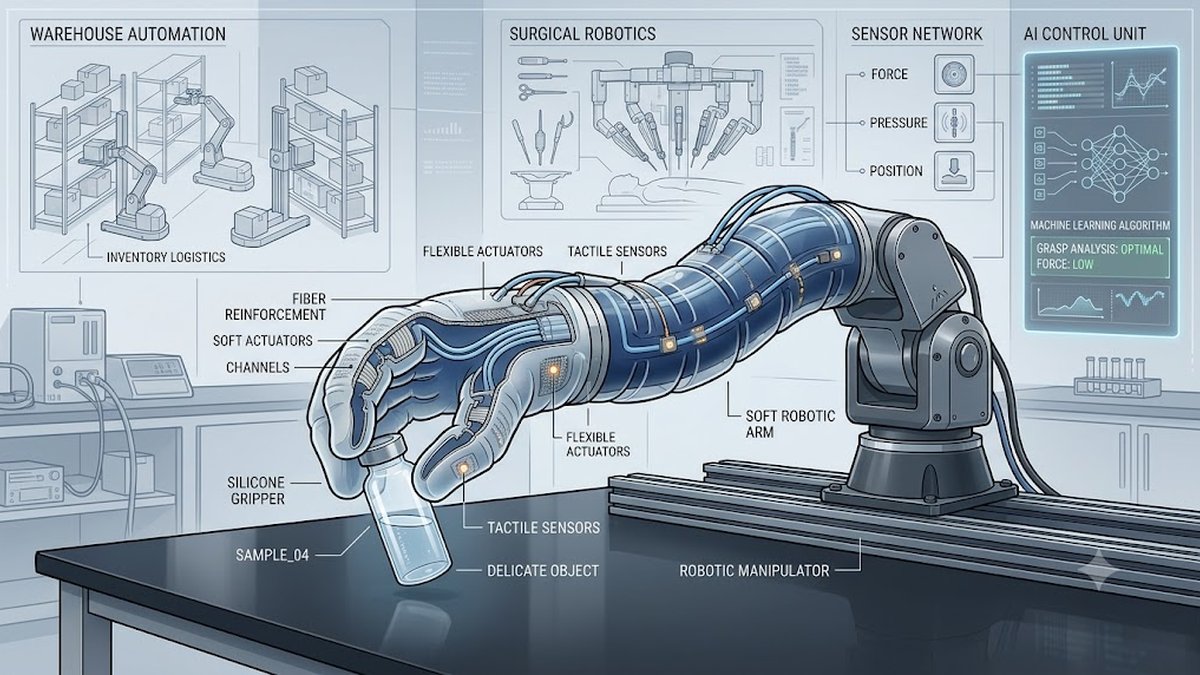
Automation has traditionally relied on rigid mechanical structures, precision-machined components, and high-powered actuators. These technologies have transformed manufacturing, logistics, and industrial production, but they also have limitations when robots must interact safely with humans, irregular objects, or delicate biological tissues.
Soft robotics represents a significant shift in this engineering paradigm. Instead of depending entirely on rigid metal links and conventional joints, soft robots use flexible, elastic, and compliant materials that can deform in response to external forces. Inspired by organisms such as octopuses, worms, caterpillars, and human muscles, these systems are designed to operate in environments where conventional robots may be too rigid, heavy, or potentially unsafe.
The rise of soft robotics is therefore not simply a change in robot design. It represents a broader movement toward automation that is adaptive, compliant, lightweight, and capable of safer interaction with people and unstructured environments.
What Is Soft Robotics?
Soft robotics is a field of robotics that focuses on robots constructed partly or substantially from compliant and deformable materials. These materials can include elastomers, silicone-based polymers, flexible composites, pneumatic structures, soft actuators, and other materials capable of controlled deformation.
Traditional industrial robots generally rely on rigid links and precisely controlled joints. Soft robots, in contrast, can change their shape during operation.
This difference enables new approaches to:
- Object manipulation
- Human-robot interaction
- Medical and surgical robotics
- Wearable and rehabilitation systems
- Agricultural automation
- Food handling
- Warehouse and logistics automation
- Search and rescue
- Exploration of confined environments
A soft robotic system may not need to know the exact geometry of an object before grasping it. Its compliant structure can sometimes conform naturally to the object's shape, reducing the need for extremely precise positioning.
Why Is Soft Robotics Becoming Important?
The growing interest in soft robotics is closely connected to the changing requirements of automation.
Conventional robots perform exceptionally well in structured environments. For example, an industrial robotic arm can repeatedly perform a welding or assembly operation with high precision when the position and characteristics of the workpiece are known.
However, many emerging applications are considerably less predictable.
A warehouse robot may need to pick products with different shapes and textures. A healthcare robot may need to interact with human tissue. An agricultural robot may encounter irregular fruits and vegetables. A collaborative robot may need to operate close to people.
In these situations, mechanical compliance can become an advantage rather than a limitation.
Editorial Insight: The objective of soft robotics is not necessarily to replace conventional industrial robots. In many applications, the greater opportunity is to combine rigid mechanical precision with soft, adaptive components where flexibility and safe interaction provide additional value.
How Soft Robots Differ From Conventional Robots
The distinction between traditional and soft robotics can be understood through several engineering characteristics.
| Characteristic | Conventional Robotics | Soft Robotics |
|---|---|---|
| Structural design | Primarily rigid components | Flexible and compliant structures |
| Interaction with objects | Often requires precise control | Can conform to object geometry |
| Human interaction | Requires dedicated safety mechanisms | Compliance can reduce contact forces |
| Materials | Metals and rigid composites | Elastomers, polymers, flexible composites |
| Deformation | Usually minimized | Intentionally utilized |
| Typical control | Position and force control | Shape, deformation, and force-aware control |
| Suitable environments | Structured environments | Unstructured and variable environments |
| Example application | Automotive assembly | Delicate object handling |
This does not mean that soft robots are universally superior. They introduce their own engineering challenges, including control complexity, material durability, sensing limitations, and manufacturing constraints.
Bio-Inspired Design: Learning From Nature
One of the defining characteristics of soft robotics is its connection with biological systems.
Nature provides numerous examples of flexible movement and adaptive manipulation. An octopus can manipulate objects without a rigid skeleton in its arms. Human muscles generate movement through soft biological tissues. Worms and other organisms can navigate constrained environments through distributed deformation.
Researchers use these biological principles to develop robotic mechanisms capable of similar adaptability.
Octopus-Inspired Robotics
Octopus-inspired robotic arms are particularly interesting because they demonstrate how distributed flexibility can provide manipulation capabilities.
Instead of relying exclusively on rigid joints, a soft robotic arm can bend continuously along its body. This can make it useful for handling irregular objects or navigating constrained spaces.
Muscle-Inspired Actuation
Another research direction involves artificial muscles and soft actuators.
These systems can use pneumatic pressure, hydraulic mechanisms, shape-memory materials, electroactive materials, or other actuation technologies to generate movement.
The broader objective is to reproduce some characteristics of biological muscles: flexibility, lightweight operation, and controlled deformation.
Soft Robotics in Healthcare and Surgery
Healthcare is one of the areas where compliant robotic systems can provide significant research opportunities.
Surgical environments require extremely careful interaction with biological tissues. Excessive mechanical force can cause damage, while insufficient control can reduce surgical effectiveness.
Soft robotic technologies are being investigated for applications including:
- Minimally invasive surgical systems
- Flexible surgical instruments
- Endoscopic devices
- Rehabilitation systems
- Prosthetic technologies
- Assistive wearable robots
- Patient-specific medical devices
The flexibility of soft structures can potentially allow robotic devices to navigate complex anatomical environments while reducing rigid mechanical contact.
However, medical applications require considerably more than mechanical innovation. Researchers must also address biocompatibility, sterilization, reliability, sensing accuracy, failure modes, clinical validation, and regulatory requirements.
Transforming Warehouse and Logistics Automation
Warehousing presents another promising environment for soft robotics.
Modern fulfillment centers contain products with dramatically different shapes, sizes, weights, textures, and packaging materials. A conventional robotic gripper designed for one object may struggle when presented with another.
Soft robotic grippers can address some of these challenges by deforming around objects.
For example, a compliant gripper may be capable of handling:
- Fragile consumer products
- Irregularly shaped packages
- Food products
- Clothing and textiles
- Soft packaging
- Objects with uncertain positioning
The combination of soft grippers, computer vision, force sensing, and machine learning could enable more adaptive robotic picking systems.
This is particularly relevant as warehouses move from highly structured automation toward systems capable of dealing with increasingly diverse inventories.
The Role of Artificial Intelligence
Soft robotics and artificial intelligence are increasingly interconnected.
A flexible robot can have many possible configurations. This creates a control problem: the system must determine how much an actuator should deform, where the robot is positioned, and how much force it is applying.
Machine learning can support these tasks by learning relationships between:
Sensor data → Robot deformation → Object interaction → Desired movement
Potential applications include:
- Vision-based object recognition
- Adaptive grasping
- Force estimation
- Motion planning
- Fault detection
- Predictive maintenance
- Learning-based control
- Real-time environmental adaptation
Researchers are also investigating simulation and data-driven approaches to reduce the difficulty of training physical robots. A major research challenge is ensuring that models trained in simulation behave reliably when transferred to real-world hardware.
Sensors Are Critical to Soft Robotics
Flexibility creates new possibilities, but it also makes sensing more difficult.
A rigid robotic arm may use encoders to determine the position of individual joints. A continuously deformable soft robot may have many possible shapes that cannot be described using only a few joint angles.
Researchers therefore investigate flexible sensing technologies capable of measuring:
- Strain
- Pressure
- Bending
- Temperature
- Contact forces
- Deformation
- Position and orientation
Embedding sensors directly into soft materials can provide the robot with a form of mechanical awareness.
This combination of soft materials + embedded sensing + intelligent control is one of the important research directions in the field.
Major Challenges Facing Soft Robotics
Despite its potential, soft robotics remains an active research field with several unresolved challenges.
1. Control Complexity
The deformation of soft materials can involve many degrees of freedom. Developing accurate mathematical models and real-time controllers can therefore be significantly more difficult than controlling conventional rigid mechanisms.
2. Material Durability
Repeated deformation can lead to fatigue, tearing, wear, or changes in material properties. Long-term reliability remains an important consideration for industrial deployment.
3. Manufacturing
Creating complex soft structures with integrated actuators and sensors can require specialized manufacturing processes.
4. Sensing
Soft materials can make precise measurement more challenging. Researchers must develop sensors that remain reliable while repeatedly stretching, bending, and compressing.
5. Energy Efficiency
Some soft actuators, particularly pneumatic systems, require additional infrastructure such as compressors and air supply systems. Developing compact and efficient actuation remains an important engineering challenge.
6. Standardization and Safety
As soft robots enter healthcare, collaborative manufacturing, and consumer applications, researchers will need appropriate testing methods, reliability standards, and safety frameworks.
Where Is the Field Heading?
The future development of soft robotics is likely to involve convergence with several other technologies.
Artificial intelligence can provide adaptive decision-making.
Advanced materials can produce stronger, lighter, and more responsive structures.
Embedded electronics can enable distributed sensing.
3D printing and advanced manufacturing can simplify fabrication of complex robotic structures.
Computer vision can help robots understand their surroundings.
Digital simulation can accelerate the development and testing of new designs.
Together, these technologies could produce robots that do more than execute predefined movements. Instead, they could sense their environment, adapt their physical configuration, and respond to uncertainty.
Research Opportunities for Engineers and PhD Scholars
Soft robotics offers a broad research landscape because it sits at the intersection of mechanical engineering, materials science, electronics, computer science, artificial intelligence, biomedical engineering, and control systems.
Potential research topics include:
- AI-based control of soft robotic manipulators
- Machine-learning-based deformation prediction
- Flexible and stretchable sensors
- Soft robotic surgical instruments
- Bio-inspired robotic locomotion
- Energy-efficient soft actuators
- Soft grippers for warehouse automation
- Wearable rehabilitation robots
- Digital twins for soft robotic systems
- Human-robot interaction using compliant mechanisms
Researchers should consider not only whether a new design works in a laboratory environment, but also whether it is repeatable, scalable, measurable, energy-efficient, durable, and transferable to real-world applications.
How to Develop a Strong Research Study in Soft Robotics
Researchers planning a soft robotics study can follow a structured approach.
1. Define a specific engineering problem.
Avoid beginning with the technology alone. Identify the practical problem that the robot is intended to solve.
2. Review existing literature systematically.
Identify established materials, actuation methods, sensors, control strategies, and evaluation metrics.
3. Define measurable performance indicators.
Examples include grasping success rate, deformation accuracy, response time, force, energy consumption, durability, and positioning error.
4. Develop and test a prototype.
Where appropriate, combine simulation with physical experiments.
5. Compare against meaningful baselines.
A new soft robotic mechanism should be evaluated against existing approaches using clearly defined criteria.
6. Report limitations transparently.
A strong research paper should explain failure cases, experimental constraints, sample sizes, and conditions that may affect reproducibility.
7. Discuss real-world applicability.
Explain how the proposed system could potentially transition from laboratory research to practical deployment.
Pro Tip: A strong robotics paper is not defined only by a novel prototype. Clearly defined research questions, reproducible experiments, quantitative evaluation, and transparent limitations are equally important when communicating engineering research.
Conclusion
Soft robotics is expanding the concept of what an automated machine can be. By replacing or complementing rigid structures with compliant materials, researchers are developing robots capable of interacting more naturally with delicate objects, people, and unpredictable environments.
Its applications range from medical devices and rehabilitation systems to warehouse automation, agriculture, manufacturing, and human-robot collaboration.
At the same time, significant challenges remain in control, sensing, durability, manufacturing, energy efficiency, and validation. These challenges create substantial opportunities for engineering researchers and interdisciplinary teams.
The future of automation may therefore not be defined solely by robots becoming stronger or faster. It may increasingly depend on robots becoming more adaptive, physically compliant, context-aware, and capable of operating safely alongside humans.
Actionable Research Checklist
Before developing or publishing a soft robotics study, researchers should ask:
- Research problem: Is the engineering problem clearly defined?
- Novelty: What is genuinely different from existing approaches?
- Materials: Are the selected materials appropriate for the application?
- Actuation: Is the actuation method efficient and reliable?
- Sensing: Can deformation and interaction forces be measured accurately?
- Control: Can the robot adapt to changing conditions?
- Evaluation: Are performance metrics quantitative and reproducible?
- Comparison: Is there an appropriate baseline or existing method for comparison?
- Safety: Have potential failure modes and human interaction risks been considered?
- Scalability: Could the proposed system operate beyond a laboratory prototype?
- Reproducibility: Are the experimental methodology and limitations sufficiently documented?
- Research impact: Does the work address a meaningful engineering or societal need?
Soft robotics remains a rapidly developing research area, making it an important field for engineers, researchers, and PhD scholars exploring the next generation of intelligent and human-centered automation.