
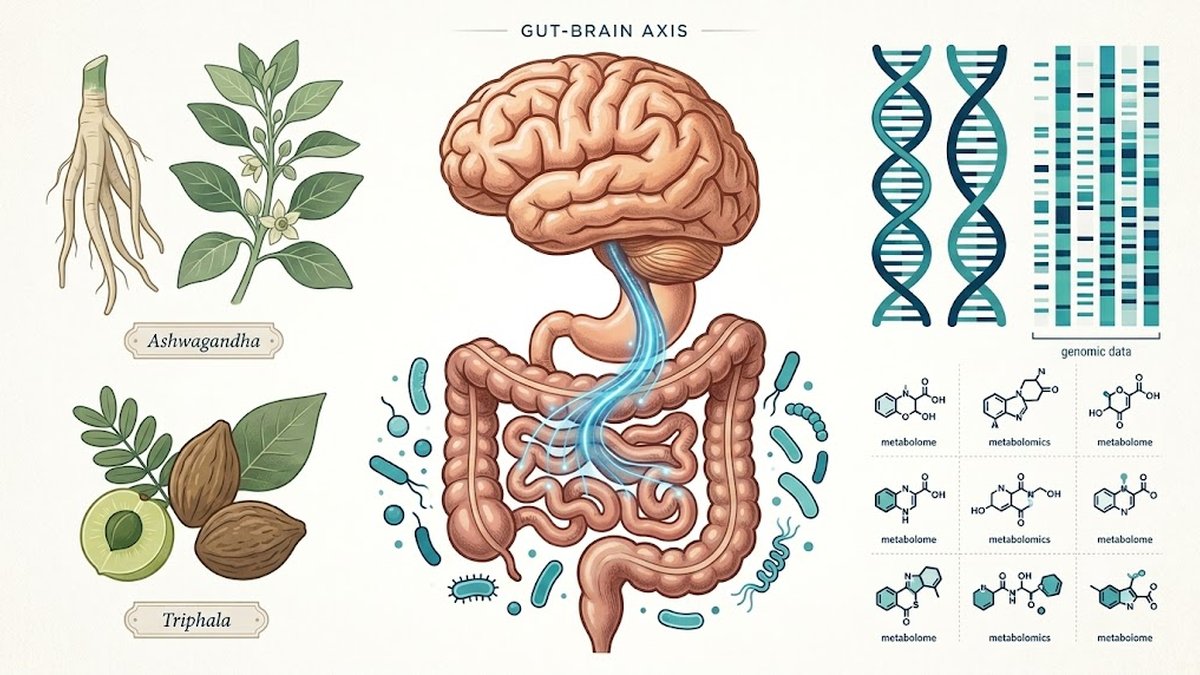
Introduction: Where Ayurveda Meets Microbiome Science
The gut-brain axis has become an important area of biomedical research because communication between the gastrointestinal tract, immune system, microbial communities, and nervous system involves multiple biological pathways. At the same time, researchers are increasingly examining traditional medicinal systems through modern experimental methods.
Ayurveda provides a particularly interesting research framework. Traditional formulations such as Triphala and botanicals such as Ashwagandha (Withania somnifera) have long histories of use, while contemporary research is investigating their phytochemical composition, physiological effects, and potential mechanisms.
The emerging question is not simply whether an Ayurvedic herb "works." A more scientifically useful question is:
How might a defined botanical preparation interact with the gut microbiome, microbial metabolites, host physiology, and ultimately gut-brain signaling—and how can these relationships be tested experimentally?
Modern 16S rRNA sequencing, shotgun metagenomics, metabolomics, and multi-omics analysis provide researchers with tools to investigate that question.
Importantly, evidence remains uneven. A randomized pilot study of Triphala found changes in fecal microbial communities, but responses were highly individualized and no universal microbial signature was identified.
This makes the field scientifically interesting precisely because substantial questions remain unanswered.
Understanding the Gut-Brain Axis
The gut-brain axis describes a complex, bidirectional communication network involving the gastrointestinal tract and central nervous system.
Several interconnected systems contribute to this communication:
- Neural signaling: The vagus nerve and enteric nervous system provide major communication routes.
- Immune signaling: Gut microbes and intestinal tissues interact with immune pathways and inflammatory mediators.
- Endocrine signaling: Hormones and stress-related pathways connect gastrointestinal physiology with systemic responses.
- Microbial metabolism: Gut microorganisms transform dietary and plant-derived compounds into metabolites that can influence host biology.
- Intestinal barrier function: Changes in the gut barrier may alter exposure of the immune system to microbial products.
This framework creates an opportunity to investigate traditional botanicals at a mechanistic level.
Rather than treating an Ayurvedic formulation as a single undifferentiated intervention, researchers can investigate its chemical constituents, microbial transformations, metabolic products, and measurable host responses.
Why Ayurvedic Adaptogens Are Receiving Research Attention
Ashwagandha is traditionally used in Ayurveda and is commonly investigated in contemporary research for areas including stress, sleep, and other health outcomes. Its bioactive constituents include withanolides. However, clinical evidence varies substantially according to the preparation, dose, population, and outcome studied.
Triphala is another extensively studied Ayurvedic formulation. It traditionally combines three fruits:
- Emblica officinalis (Phyllanthus emblica)
- Terminalia chebula
- Terminalia bellirica
Its chemical composition includes numerous polyphenolic and other bioactive compounds, making it particularly interesting for microbiome research.
A growing body of research has highlighted the potential relationship between Triphala and gut microbiota while also emphasizing the need for more rigorous studies to determine which constituents influence microbial communities and through which mechanisms.
What Microbiome Sequencing Adds
Traditional descriptions of herbal medicines generally do not provide the same type of molecular resolution as modern biological techniques.
Microbiome sequencing can help researchers ask:
- Which bacterial taxa are present before treatment?
- Does the relative abundance of particular microorganisms change?
- Are microbial communities becoming more or less diverse?
- Are changes consistent across participants?
- Do particular microbial responses correlate with clinical outcomes?
16S rRNA Sequencing
16S rRNA gene sequencing is widely used for bacterial community profiling. It can provide a relatively cost-effective view of bacterial composition and taxonomic changes.
However, 16S sequencing has limitations. It generally provides less functional information than shotgun metagenomic sequencing and may not identify organisms to species or strain level reliably.
Shotgun Metagenomics
Shotgun metagenomics sequences broader microbial DNA content. This can provide information about:
- microbial species and strains,
- functional genes,
- metabolic pathways,
- antimicrobial-resistance genes,
- microbial community structure.
For researchers investigating botanical interventions, this can help move from the question "Which microbes changed?" toward "What biological functions may have changed?"
Why Metabolomics Matters
Microbiome composition alone does not tell the complete biological story.
Two participants can have different microbial communities while producing similar metabolites. Conversely, relatively small microbial changes can potentially generate meaningful metabolic differences.
This is where metabolomics becomes valuable.
Metabolomic analysis measures large numbers of small molecules in biological samples such as:
- blood,
- urine,
- feces,
- saliva,
- tissue samples.
Researchers can investigate metabolites associated with microbial fermentation, amino-acid metabolism, bile-acid pathways, short-chain fatty acids, tryptophan metabolism, and other biochemical processes.
A human gut-model study investigating Triphala used both 16S rRNA sequencing and untargeted metabolomics. While the microbial-profile findings did not demonstrate a statistically significant treatment effect in that experimental model, the metabolomic analysis identified substantial differences in numerous metabolites and pathways.
This illustrates an important principle: microbiome composition and microbial metabolism should not automatically be treated as interchangeable measurements.
From Traditional Botanical to Multi-Omics Research
A modern research workflow can connect traditional knowledge with molecular evidence.
| Research Layer | Example Method | Primary Question |
|---|---|---|
| Traditional knowledge | Classical Ayurvedic literature | What is the traditional rationale? |
| Botanical characterization | HPLC/LC-MS | What compounds are present? |
| Microbial composition | 16S rRNA sequencing | Which bacterial communities change? |
| Microbial function | Shotgun metagenomics | Which genes/pathways may change? |
| Metabolic response | Metabolomics | Which metabolites change? |
| Host response | Cytokines, hormones, clinical biomarkers | Does the host respond biologically? |
| Clinical outcomes | Validated questionnaires/clinical measures | Does the intervention produce meaningful outcomes? |
The strongest studies can integrate several of these layers rather than relying on a single endpoint.
What Existing Evidence Shows About Triphala
One informative human study was a double-blind, randomized, placebo-controlled pilot study involving 31 healthy participants. Researchers evaluated Triphala, Manjistha, or placebo over four weeks and used 16S rRNA profiling to investigate fecal microbial communities.
The investigators reported that microbial responses were highly personalized. They observed trends involving the Firmicutes-to-Bacteroidetes ratio and Akkermansia muciniphila, but importantly, there was no single microbial response that occurred uniformly across participants.
This finding has major implications for future research.
Researchers should avoid assuming that a botanical produces one predictable microbiome signature in every individual.
The microbiome is influenced by:
- diet,
- age,
- geography,
- medication exposure,
- baseline health,
- physical activity,
- sleep,
- genetics,
- existing microbial ecology.
Consequently, baseline microbiome profiling and careful participant characterization are essential.
The Research Case for Ashwagandha
Ashwagandha presents another interesting research opportunity, although its microbiome-specific evidence is currently less established than the broader clinical literature surrounding the botanical.
Contemporary human research has investigated Ashwagandha for stress and sleep, among other outcomes. Some preparations have demonstrated potential benefits in these areas, while evidence remains limited by differences in study design, sample sizes, preparations, and populations.
A future gut-brain study could investigate whether measurable microbiome or metabolomic changes accompany physiological outcomes such as validated stress scores, sleep measures, inflammatory markers, or neuroendocrine biomarkers.
That would be substantially stronger than simply measuring whether participants report "feeling better."
Designing a Rigorous Ayurvedic Microbiome Study
Researchers planning studies in this area should adopt rigorous experimental standards.
1. Define the Botanical Precisely
"Triphala" or "Ashwagandha" is not necessarily one standardized chemical entity.
Researchers should document:
- botanical identity,
- plant part,
- extraction method,
- source,
- batch information,
- chemical standardization,
- dosage,
- administration schedule.
Without this information, reproducibility becomes difficult.
2. Establish a Strong Control Group
Randomized controlled designs can help separate intervention-associated changes from changes caused by diet, lifestyle, placebo effects, or natural microbiome variation.
3. Collect Baseline Samples
Pre-intervention stool, blood, and relevant clinical measurements can establish individual starting points.
Longitudinal sampling can then identify whether observed changes persist, disappear, or fluctuate.
4. Control Major Confounders
Researchers should document factors such as:
- recent antibiotic use,
- probiotics,
- dietary changes,
- medications,
- gastrointestinal disorders,
- physical activity,
- sleep,
- alcohol consumption.
These variables can substantially complicate microbiome interpretation.
5. Combine Microbiome and Clinical Data
A microbial change should not automatically be interpreted as a health benefit.
For example, an increase in a particular bacterial taxon is not inherently beneficial unless supported by functional, metabolic, or clinical evidence.
Common Mistakes in Ayurvedic Microbiome Research
Editorial Insight: A change in microbiome composition is a biological observation—not automatically proof of therapeutic efficacy. Strong research connects microbial changes with reproducible functional and clinically meaningful outcomes.
Several methodological problems can weaken otherwise interesting studies.
Overinterpreting relative abundance: Microbiome sequencing frequently reports relative rather than absolute abundance. A percentage increase does not necessarily mean that the absolute population increased.
Treating association as causation: A correlation between a microbial taxon and a clinical outcome does not prove that the microorganism caused the outcome.
Ignoring batch variability: Herbal preparations can vary in phytochemical composition.
Using inadequate sample sizes: Small pilot studies can generate hypotheses but may not establish robust clinical conclusions.
Relying on one omics layer: Microbial composition alone provides an incomplete picture.
Ignoring individual variability: Human microbiome research demonstrates why personalized microbial responses deserve careful consideration.
Safety and Translational Considerations
Scientific enthusiasm should be balanced with safety assessment.
Triphala has undergone small human safety investigations, including a Phase I study of an aqueous extract in healthy volunteers. Such findings should not be interpreted as proof of long-term safety or safety for all populations.
Ashwagandha also requires appropriate safety consideration. Researchers should carefully document adverse events, contraindications, medication use, and participant exclusion criteria.
For academic publications, researchers should clearly report adverse events, exclusion criteria, concomitant medications, product specifications, and study duration.
Opportunities for PhD Scholars and Researchers
The intersection of Ayurveda, microbiome science, and metabolomics provides numerous research opportunities.
Potential research questions include:
- Can specific Triphala constituents be linked to reproducible microbial transformations?
- Do individual baseline microbiome profiles predict response to Ayurvedic botanicals?
- Which microbial metabolites are altered following standardized botanical exposure?
- Can metabolomic signatures explain differences in clinical response?
- Do microbiome changes correlate with validated stress or sleep outcomes?
- Can shotgun metagenomics identify functional pathways affected by botanical treatment?
- How does the response differ between healthy participants and defined clinical populations?
Researchers can also investigate personalized Ayurveda, where baseline biological characteristics are used to explore differences in response rather than assuming identical effects across populations.
Reporting Standards for High-Quality Publications
For researchers preparing manuscripts in this area, methodological transparency is essential.
A strong manuscript should clearly describe:
- botanical authentication,
- formulation composition,
- extraction and standardization,
- dosage,
- participant characteristics,
- randomization,
- control conditions,
- stool collection procedures,
- DNA extraction methods,
- sequencing platform,
- bioinformatics pipeline,
- statistical methods,
- metabolomics platform,
- quality-control procedures,
- missing-data handling,
- adverse-event monitoring.
This level of reporting makes findings easier to reproduce and compare across studies.
The Future: From Traditional Knowledge to Systems Biology
The most promising direction is not replacing Ayurvedic knowledge with molecular biology or treating traditional claims as automatically scientifically proven.
Instead, the opportunity is to create testable bridges between traditional knowledge and contemporary biomedical research.
A standardized botanical can be chemically characterized. Its interaction with microbial communities can be sequenced. Microbial functional changes can be investigated through metagenomics. Metabolic consequences can be measured through metabolomics. Host responses can then be evaluated using validated physiological and clinical endpoints.
This creates a systems-level research framework:
Traditional knowledge → standardized intervention → microbiome → microbial metabolites → host pathways → clinical outcomes
Such an approach can transform broad traditional hypotheses into experimentally testable research questions.
Actionable Checklist for Researchers
Before submitting an Ayurveda–microbiome study, researchers should ask:
- Botanical identity: Is the intervention authenticated and standardized?
- Reproducibility: Is the formulation and batch information reported?
- Study design: Is there an appropriate control and longitudinal sampling strategy?
- Microbiome methodology: Are sequencing and bioinformatics methods transparent?
- Metabolomics: Are important metabolic pathways investigated where appropriate?
- Confounders: Are diet, medication, antibiotics, and lifestyle adequately documented?
- Statistics: Is the sample size appropriate for the planned analysis?
- Clinical relevance: Are microbiome findings connected to validated outcomes?
- Safety: Are adverse events and contraindications reported?
- Interpretation: Are associations clearly distinguished from causal conclusions?
Conclusion
The meeting point between the gut-brain axis, Ayurvedic medicine, microbiome sequencing, and metabolomics represents an emerging interdisciplinary research field.
Triphala provides an example of how traditional botanical formulations can be investigated using modern microbial sequencing, while Ashwagandha offers opportunities for future research connecting botanical exposure with physiological and potentially microbiome-related pathways. Existing evidence supports continued investigation but remains insufficient to establish broad clinical conclusions from microbiome findings alone.
For PhD scholars and academicians, the strongest opportunity lies in rigorous study design: standardized botanicals, adequately powered controlled trials, longitudinal microbiome sampling, multi-omics integration, transparent statistics, and clinically meaningful endpoints.
The goal should not simply be to demonstrate that an ancient remedy changes bacteria. The more important scientific question is whether reproducible biological changes can be identified, understood mechanistically, and connected to meaningful health outcomes.
That is where traditional knowledge and modern systems biology can productively meet.