
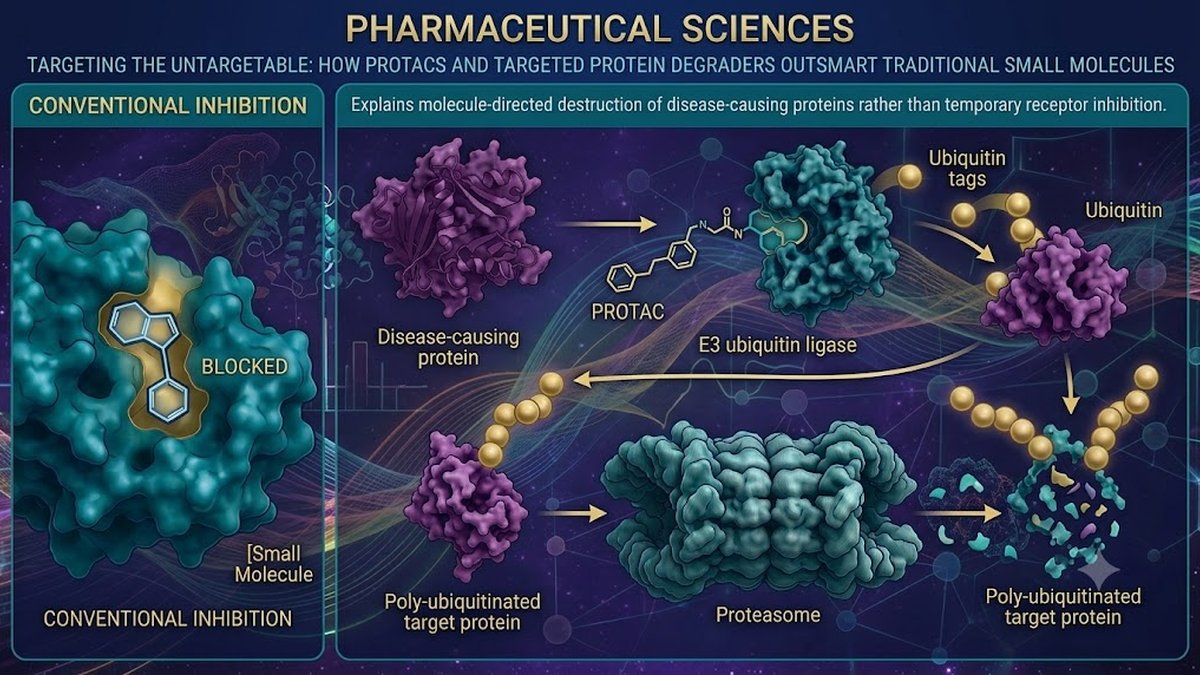
For decades, conventional small-molecule drug discovery has largely followed an occupancy-driven model: a drug binds to a functional site on a protein and suppresses or modifies its activity for as long as sufficient drug concentration and target engagement are maintained.
This approach has produced many successful medicines. However, it also creates a fundamental limitation: some disease-associated proteins lack suitable binding pockets, while others can develop mutations that reduce inhibitor binding or retain important biological functions outside the inhibited site.
Targeted protein degradation (TPD) introduces a different pharmacological strategy. Instead of simply blocking a protein, a degrader can recruit the cell's own protein-disposal machinery to remove the protein itself.
Among the most prominent technologies in this field are proteolysis-targeting chimeras (PROTACs). PROTACs are bifunctional molecules that bring a protein of interest into proximity with an E3 ubiquitin ligase, enabling ubiquitination and subsequent degradation through the proteasome.
The result is a shift from "inhibit the protein" toward "eliminate the protein."
What Are PROTACs?
A PROTAC is generally composed of three functional components:
- A target-protein ligand
- A linker
- An E3-ligase-recruiting ligand
These components work together to create a productive interaction between the target protein and an E3 ubiquitin ligase.
The resulting proximity enables the E3 ligase to facilitate ubiquitination of the target. The ubiquitinated protein is then recognized by the proteasome and degraded.
Importantly, the PROTAC itself is not necessarily consumed during every degradation event. This event-driven mechanism distinguishes targeted protein degradation from conventional occupancy-driven inhibition and can create pharmacological effects that persist beyond simple target binding.
From Protein Inhibition to Protein Elimination
The difference becomes clearer when conventional inhibitors and PROTACs are compared.
| Feature | Conventional Small Molecule | PROTAC / Targeted Degrader |
|---|---|---|
| Primary action | Inhibits or modulates protein activity | Promotes protein degradation |
| Pharmacological model | Usually occupancy-driven | Event-driven |
| Binding requirement | Often requires a functional pocket | Can exploit alternative binding sites |
| Target consequence | Protein remains present | Protein abundance is reduced |
| Cellular machinery | Mainly depends on drug-target interaction | Recruits endogenous degradation machinery |
| Potential advantage | Often smaller and orally developable | Can address selected difficult-to-inhibit proteins |
| Major challenge | Resistance or incomplete functional suppression | Size, delivery, pharmacokinetics and selectivity |
This does not mean PROTACs universally outperform conventional medicines. Instead, they introduce a different pharmacological mechanism that may be advantageous for particular targets and disease contexts.
How the PROTAC Mechanism Works
The mechanism can be understood as a sequence of molecular events.
Step 1: Target recognition
One end of the PROTAC binds the protein of interest.
The target can be an oncogenic protein, transcriptional regulator, signaling protein, or another disease-associated protein for which an appropriate ligand can be developed.
Step 2: E3-ligase recruitment
The second ligand binds an E3 ubiquitin ligase.
E3 ligases are components of the cellular ubiquitin system that help determine which proteins receive ubiquitin tags.
Step 3: Ternary complex formation
The target protein, PROTAC, and E3 ligase form a productive molecular assembly.
This induced proximity is central to the technology.
Step 4: Ubiquitination
The E3 machinery facilitates attachment of ubiquitin to the target protein.
Step 5: Proteasomal degradation
The ubiquitinated target is delivered to the proteasome, where it is degraded.
The result is a reduction in the cellular abundance of the disease-associated protein.
This mechanism is one reason targeted protein degradation has become a major area of pharmaceutical research.
Why PROTACs Are Important for "Undruggable" Targets
The phrase "undruggable target" generally refers to a protein that has historically been difficult to modulate using conventional drug-discovery approaches.
Traditional inhibitors often depend on finding a suitable binding pocket capable of producing the desired functional effect.
Targeted degradation changes the question.
Instead of asking:
"Can we find a molecule that blocks the protein's function?"
researchers can ask:
"Can we recruit this protein into a cellular degradation pathway?"
That distinction can expand the range of proteins considered therapeutically tractable.
However, "undruggable" should not be interpreted as meaning that PROTACs can automatically degrade any protein. Target engagement, suitable ligands, productive ternary-complex formation, accessible cellular localization, E3-ligase availability, and pharmacokinetic properties all remain important constraints.
PROTACs and Molecular Glues
PROTACs are part of a broader family of targeted protein degradation technologies.
Another major approach is the molecular glue degrader.
Unlike conventional PROTACs, molecular glues are generally smaller monovalent molecules that stabilize or induce an interaction between an E3 ligase and a protein substrate. This can lead to ubiquitination and degradation without requiring the classic three-part PROTAC architecture.
Both approaches exploit induced molecular proximity, but their chemical design principles differ.
| Property | PROTACs | Molecular Glues |
|---|---|---|
| Basic architecture | Typically bifunctional | Generally monovalent |
| Target/E3 interaction | Designed through two ligands | Induced or stabilized by a single molecule |
| Linker | Usually present | Usually absent |
| Discovery approach | Often structure-guided/rational | Can involve phenotypic or screening-based discovery |
| Key opportunity | Programmable target degradation | Access to novel protein–E3 interactions |
| Major challenge | Molecular size and drug-like properties | Predicting and controlling new degradation interactions |
Both modalities are being investigated clinically, and the broader TPD field now contains numerous investigational programs.
Why Protein Degradation Can Be Pharmacologically Different
One of the most interesting concepts in TPD is event-driven pharmacology.
A conventional inhibitor generally needs continued target engagement to maintain inhibition.
A degrader instead triggers a biological event—target ubiquitination and destruction.
This can produce a pharmacological effect that is not simply proportional to the amount of drug occupying the target at every moment.
Recent reviews describe this distinction as one of the conceptual foundations of TPD and a potential way to overcome some limitations of conventional occupancy-driven pharmacology.
For pharmaceutical scientists, this means that traditional measures such as binding affinity alone may not fully describe degrader performance.
Researchers may also need to investigate:
- ternary-complex formation,
- degradation rate,
- degradation depth,
- DC50,
- Dmax,
- cellular permeability,
- E3-ligase dependency,
- target resynthesis,
- and pharmacodynamic duration.
The Importance of Ternary Complexes
A particularly important concept in PROTAC research is that ternary-complex formation is not simply a mathematical consequence of two independent binding events.
The physical arrangement of the target, PROTAC, and E3 ligase can determine whether ubiquitination occurs efficiently.
Therefore, a PROTAC with strong binary binding characteristics does not necessarily produce strong degradation.
This creates an important research opportunity in structural biology and computational drug discovery.
Researchers can investigate:
- protein–PROTAC interfaces,
- linker geometry,
- cooperativity,
- ternary-complex stability,
- solvent exposure,
- and ubiquitination-compatible orientations.
Such studies can support more rational degrader design.
Applications in Oncology
Cancer has become one of the most prominent areas for targeted protein degradation.
Many cancers depend on proteins that regulate transcription, hormone signaling, cell-cycle progression, DNA repair, or other critical cellular processes.
The 2025 Nature Reviews Cancer review describes TPD as an increasingly important strategy in cancer drug discovery, highlighting advances in PROTACs and molecular glue degraders.
The field has also expanded beyond laboratory studies. Reviews of clinical translation report increasing numbers of degraders entering clinical trials, although clinical programs have historically concentrated on a relatively limited set of targets and E3 ligases.
This creates two parallel research goals:
First: develop degraders against validated disease targets.
Second: expand the range of proteins and cellular contexts that can be successfully degraded.
Beyond Oncology
Although cancer remains a major focus, targeted protein degradation is not restricted to oncology.
Researchers are investigating TPD approaches across areas including:
- Immunology
- Neurological disorders
- Inflammatory diseases
- Infectious diseases
- Genetic disorders
- Protein-misfolding diseases
Recent reviews also describe emerging approaches that extend degradation beyond conventional intracellular proteasomal targets, including lysosome-directed and autophagy-related technologies.
This expansion could eventually allow researchers to consider degradation of membrane-associated or extracellular proteins that are difficult to address using conventional intracellular PROTAC designs.
Major Challenges in PROTAC Development
The scientific promise of PROTACs does not eliminate conventional pharmaceutical-development problems.
Molecular size
Many PROTAC molecules are considerably larger than traditional small-molecule drugs.
This can influence:
- membrane permeability,
- oral absorption,
- tissue distribution,
- metabolic stability,
- and pharmacokinetics.
These properties can make drug development more complex.
Bioavailability and delivery
A potent degrader in a cellular assay may not achieve adequate exposure in the desired tissue.
Improving pharmacokinetic and delivery properties remains a major translational challenge.
E3-ligase limitations
The human genome contains many E3 ligases, but only a relatively small subset has been extensively exploited for therapeutic degradation.
Expanding the usable E3-ligase repertoire could increase target and tissue selectivity.
Off-target degradation
A degrader must be evaluated not only for whether it removes the intended target but also for whether it causes unintended degradation of other proteins.
Proteomic analysis is therefore an important component of modern TPD development.
Resistance
Cancer cells and other disease systems can potentially develop resistance through changes in:
- target protein sequence,
- E3-ligase expression,
- ubiquitination machinery,
- drug transport,
- or downstream signaling.
Understanding resistance mechanisms is becoming an important area of pharmaceutical research.
The Role of Artificial Intelligence in PROTAC Discovery
Artificial intelligence and computational chemistry are increasingly relevant to targeted protein degradation.
Potential applications include:
- Protein-structure analysis
- Ligand discovery
- Linker optimization
- Ternary-complex prediction
- Molecular-property prediction
- Degradation-response modeling
- Proteomics data analysis
- Resistance prediction
However, AI-generated molecules still require experimental validation.
For researchers, a strong computational study should connect predictions to measurable biological endpoints rather than treating molecular-generation metrics as evidence of therapeutic efficacy.
Pro Tip: For a PROTAC research project, define the biological endpoint before optimizing the molecule. A compound with excellent binding properties is not necessarily an effective degrader; measure target degradation, selectivity, cellular activity, and pharmacological behavior systematically.
Emerging Activatable PROTACs
One important direction is the development of activatable or conditional PROTACs.
The goal is to keep the degrader inactive until it reaches a particular biological environment or receives an external stimulus.
Researchers are investigating approaches involving:
- tumor-associated conditions,
- enzymatic activation,
- light activation,
- and bioorthogonal chemistry.
These strategies are designed to improve spatial and temporal control over protein degradation and potentially reduce unwanted activity in healthy tissues. Recent 2026 literature identifies tissue specificity, off-target toxicity, and insufficient tumor accumulation as important reasons for pursuing activatable PROTAC designs.
Research Opportunities for PhD Scholars
PROTAC research provides opportunities across several disciplines.
Pharmaceutical chemistry
Investigate ligand optimization, linker design, molecular properties, and structure–activity relationships.
Pharmacology
Study degradation kinetics, pharmacodynamic responses, dose–response relationships, and target resynthesis.
Structural biology
Characterize target–PROTAC–E3 ternary complexes and investigate molecular determinants of productive degradation.
Computational drug discovery
Develop models for degrader design, ternary-complex prediction, and molecular-property optimization.
Proteomics
Measure target and off-target protein changes across the proteome.
Translational medicine
Evaluate pharmacokinetics, tissue exposure, biomarkers, therapeutic windows, and resistance mechanisms.
This multidisciplinary structure makes TPD particularly suitable for collaborative pharmaceutical research.
A Practical Research Framework
Researchers designing a PROTAC study can consider the following workflow:
- Select a biologically validated disease target.
- Identify a suitable target-binding ligand.
- Select an appropriate E3-ligase system.
- Design and optimize linker chemistry.
- Evaluate ternary-complex formation.
- Measure target degradation in relevant cells.
- Quantify degradation potency and maximum degradation.
- Assess proteome-wide selectivity.
- Evaluate pharmacokinetics and tissue exposure.
- Investigate resistance and target recovery.
- Validate efficacy in appropriate disease models.
- Define translational biomarkers before clinical investigation.
For PhD scholars, documenting each stage separately can also make the resulting research more reproducible and easier to translate into a coherent publication.
What the Future of Targeted Protein Degradation May Look Like
The field is moving from the initial demonstration that proteins can be deliberately degraded toward a broader question:
How precisely can protein degradation be controlled?
Future research is likely to focus on:
- expanding E3-ligase utilization,
- improving oral bioavailability,
- reducing molecular size,
- achieving tissue-selective degradation,
- developing conditional degraders,
- targeting extracellular proteins,
- combining degradation with other therapeutic modalities,
- and identifying new classes of degradable disease proteins.
Recent 2026 reviews emphasize both the rapid expansion of TPD and the continuing need to improve selectivity, delivery, bioavailability, and clinical translation.
The most important development may therefore not be a single new PROTAC, but a broader platform for controlling protein abundance with pharmaceutical precision.
Actionable Checklist for Researchers
Before developing or submitting research on PROTACs or targeted protein degradation, consider:
- Define the disease-relevant protein and biological rationale.
- Explain why conventional inhibition may be insufficient for the research question.
- Identify the target ligand and E3-ligase ligand clearly.
- Justify linker selection and molecular design.
- Measure actual protein degradation rather than relying only on binding affinity.
- Report degradation potency, maximum degradation, and relevant kinetics.
- Evaluate target selectivity using appropriate proteomic or biochemical approaches.
- Assess cellular permeability and pharmacokinetic properties.
- Investigate potential resistance mechanisms.
- Distinguish preclinical evidence from clinical evidence.
- Avoid describing a target as permanently "undruggable" when the evidence is still evolving.
- Discuss limitations in bioavailability, delivery, selectivity, and E3-ligase availability.
Conclusion
PROTACs and other targeted protein degraders represent a significant change in the conceptual framework of modern drug discovery. Rather than requiring continuous inhibition of a disease-associated protein, these molecules can redirect endogenous cellular machinery toward selective protein elimination.
The distinction between occupancy-driven inhibition and event-driven degradation is central to understanding why TPD has attracted substantial pharmaceutical interest. PROTACs, molecular glues, and emerging degradation platforms are now being explored across a growing range of therapeutic targets.
At the same time, targeted protein degradation is not a universal replacement for conventional small molecules. Molecular size, delivery, pharmacokinetics, E3-ligase availability, selectivity, resistance, and tissue specificity remain important development challenges.
For pharmaceutical scientists, however, the field opens a powerful research direction: instead of asking only how to inhibit a disease-causing protein, researchers can investigate how to control its cellular lifetime.
That shift—from blocking function to regulating protein abundance—could become one of the defining concepts in next-generation drug discovery.