
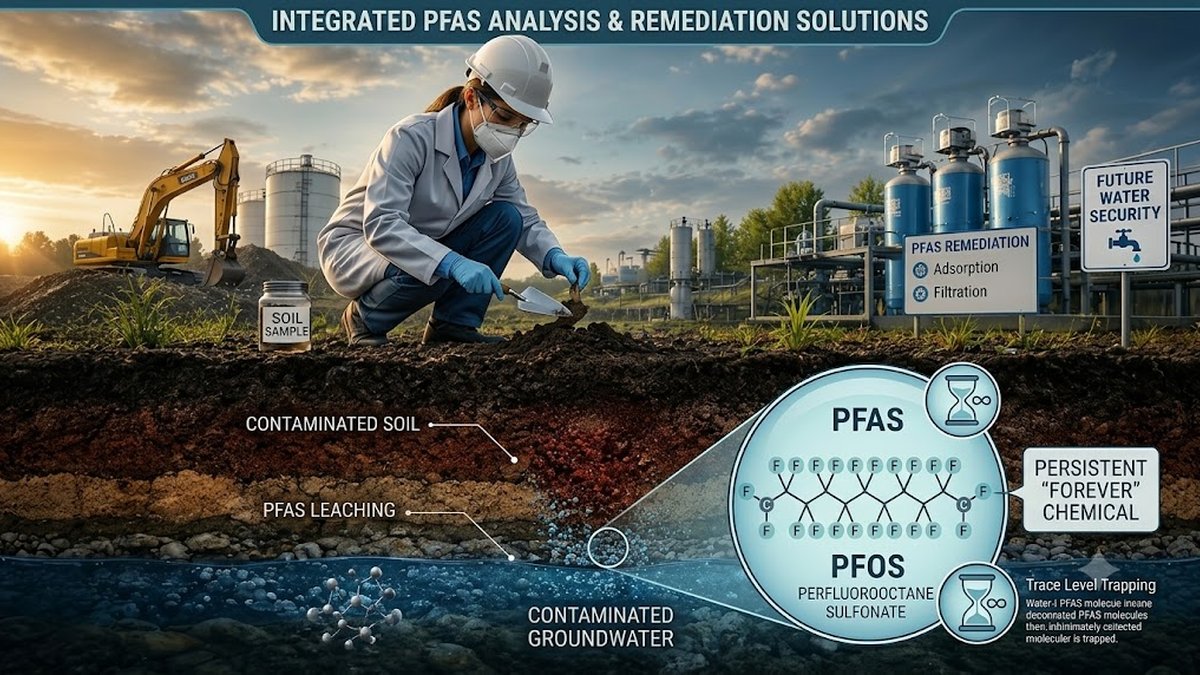
Introduction: The Challenge of the “Forever Chemicals”
Per- and polyfluoroalkyl substances, commonly known as PFAS, have become one of the most persistent challenges in modern environmental science. These synthetic chemicals have been used in applications ranging from firefighting foams and industrial processes to consumer products because of their resistance to heat, water, oil, and chemical degradation.
That same chemical stability creates a major environmental problem.
PFAS contain strong carbon–fluorine bonds that can make many members of the group extremely persistent in environmental systems. As a result, conventional water-treatment processes may remove PFAS from water without actually destroying the molecules.
This distinction is fundamental.
Removal is not necessarily destruction.
Technologies such as granular activated carbon, ion-exchange resins, and high-pressure membranes can capture or separate PFAS from contaminated water. However, the resulting concentrated PFAS-containing waste still requires management.
This has intensified research into PFAS destruction technologies that aim to break down PFAS molecules rather than simply transfer them from one medium to another. Among the technologies receiving significant research attention are supercritical water oxidation (SCWO) and electrochemical oxidation. The U.S. Environmental Protection Agency identifies both among emerging PFAS destruction technologies requiring continued research and validation.
The scientific challenge is therefore shifting from:
“How do we remove PFAS from water?”
to:
“How can we reliably destroy PFAS and demonstrate that fluorinated compounds have not simply been transformed into other persistent products?”
What Makes PFAS So Difficult to Destroy?
PFAS are a large family of fluorinated chemicals rather than a single substance.
Their structures can contain highly fluorinated carbon chains and different functional groups. This structural diversity means that a treatment process effective for one PFAS compound may not perform identically against another.
The carbon–fluorine bond is particularly important.
Fluorine is highly electronegative, and the resulting molecular structures can be unusually resistant to many biological, chemical, and thermal degradation pathways.
This persistence has made PFAS useful for industrial applications while simultaneously creating difficulties for environmental remediation.
Why Conventional Treatment Is Not Enough
Conventional water treatment may reduce measured concentrations of individual PFAS compounds.
However, treatment can involve several different outcomes:
- Physical separation: PFAS is transferred from water to another material.
- Adsorption: PFAS attaches to activated carbon or another sorbent.
- Membrane separation: PFAS is concentrated into a reject stream.
- Chemical transformation: PFAS is converted into other compounds.
- Destruction: Molecular structures are sufficiently degraded and fluorine is accounted for.
These outcomes should not be treated as equivalent.
Editorial Insight: A credible PFAS destruction study should evaluate not only the disappearance of target PFAS compounds but also transformation products, fluoride release, total organic fluorine where appropriate, and relevant mass balances.
From PFAS Removal to PFAS Destruction
PFAS management can broadly be divided into separation technologies and destruction technologies.
| Approach | Basic Principle | Main Advantage | Key Challenge |
|---|---|---|---|
| Granular activated carbon | Adsorbs PFAS | Established treatment technology | Generates PFAS-containing spent carbon |
| Ion exchange | Captures PFAS on resin | Effective for many PFAS | Resin requires regeneration or disposal |
| Reverse osmosis | Separates PFAS through membranes | High removal capability | Produces concentrated reject stream |
| Electrochemical oxidation | Uses electrochemical reactions to transform PFAS | Potential on-site destruction | Energy, electrode, matrix, and byproduct considerations |
| Supercritical water oxidation | Oxidizes contaminants under supercritical conditions | Potential destruction of concentrated PFAS streams | High temperature, pressure, corrosion, salts, and energy requirements |
| Thermal treatment | Uses controlled high-temperature processes | Applicable to certain PFAS-containing wastes | Emission and destruction verification requirements |
The important distinction is that separation technologies primarily concentrate or transfer PFAS, while destruction technologies attempt to break down the molecular structures.
In practice, the two approaches may also be combined.
A treatment system could first concentrate PFAS from a large volume of dilute water and then apply a destruction technology to the smaller, concentrated stream.
Supercritical Water Oxidation: Turning Water Into a Reaction Medium
One of the most interesting approaches is supercritical water oxidation.
Water normally exists as a liquid or gas depending on temperature and pressure. Above its critical point—approximately 374°C and 221 bar—water enters a supercritical state with unusual physical and chemical properties. EPA describes SCWO as a process in which oxidation reactions are accelerated under these conditions.
In a simplified conceptual model:
PFAS-contaminated stream + oxidant + supercritical water conditions → chemical transformation and mineralization products
Under these conditions, organic compounds can undergo rapid oxidation.
The objective for PFAS treatment is to disrupt the highly stable molecular structure and ultimately convert the carbon and fluorine into simpler chemical forms.
The technology is particularly interesting for concentrated waste streams because treating highly contaminated material can be more practical than processing enormous volumes of dilute water.
How SCWO Works
A simplified SCWO process includes several stages.
1. Feed Preparation
The contaminated liquid stream is prepared for processing.
Researchers must characterize:
- PFAS concentration,
- organic matter,
- inorganic salts,
- dissolved solids,
- pH,
- potential corrosion-causing constituents.
2. Pressurization
The water stream is pressurized above the critical pressure of water.
3. Heating
The system is heated above the critical temperature.
At this point, water behaves very differently from ordinary liquid water.
4. Oxidation
An oxidant is introduced, allowing organic contaminants to undergo rapid oxidation under supercritical conditions.
5. Reaction and Residence Time
The system is designed to provide sufficient temperature, pressure, mixing, and residence time for the desired destruction reactions.
6. Cooling and Separation
The treated stream is cooled and depressurized.
Researchers then analyze the resulting liquid, gas, and solid fractions.
This final analytical stage is crucial.
A reduction in measured PFOA or PFOS concentration alone does not prove complete destruction of all PFAS-related material.
What Recent SCWO Research Shows
EPA research has investigated SCWO using PFAS-containing aqueous film-forming foams (AFFF). Earlier demonstrations involving several SCWO systems reported greater than 99% destruction of the targeted PFAS measured in the treated streams. However, EPA has also emphasized important limitations, including the need for additional analysis of transformation products and PFAS not captured by targeted analytical methods.
More recent field work has continued to examine SCWO under practical conditions.
A 2024 study of SCWO treatment of several alcohol-resistant AFFF formulations reported at least three-log destruction of measured PFAS and greater than 99.9% destruction across tested dilutions. The study also identified issues requiring continued attention, including fluorine mass balance and the formation of precipitated salts.
These findings demonstrate both the potential and the complexity of the technology.
The Importance of Fluorine Mass Balance
PFAS research requires a fundamental accounting principle:
Where did the fluorine go?
Suppose analytical testing shows that 99.9% of a particular PFAS disappears from the water.
That result is encouraging, but it does not automatically establish that 99.9% of the fluorine has been safely destroyed.
The fluorine may potentially appear in:
- dissolved fluoride,
- other fluorinated transformation products,
- gas-phase compounds,
- solid residues,
- unmeasured PFAS,
- unidentified organofluorine compounds.
Therefore, advanced PFAS destruction studies increasingly emphasize mass-balance approaches and broader chemical characterization.
This is one of the most important areas for future environmental analytical research.
Electrochemical Oxidation: Destroying PFAS at the Electrode
Electrochemical oxidation (EO) represents another promising pathway.
Instead of relying primarily on high-temperature and high-pressure water, electrochemical systems use electrical energy and specially designed electrodes to promote oxidation reactions.
A simplified system consists of:
Contaminated water → electrochemical cell → anode/cathode reactions → PFAS transformation → treated stream
The electrode material is critically important.
Researchers investigate materials and surface structures that can generate reactive species or directly facilitate PFAS degradation.
Potential advantages include:
- modular equipment,
- controllable electrical input,
- potential on-site treatment,
- compatibility with concentrated waste streams,
- integration with other treatment processes.
However, electrochemical PFAS destruction is not without limitations.
The Challenges of Electrochemical PFAS Treatment
Laboratory results can sometimes overestimate real-world performance.
An ACS review highlighted concerns that electrochemical experiments using high PFAS concentrations or highly conductive supporting electrolytes may not represent practical treatment conditions. The review also emphasized the importance of evaluating potentially undesirable products such as chlorate and perchlorate where relevant.
Important engineering questions include:
- How long can electrodes operate?
- How does electrode fouling affect performance?
- What happens in complex municipal wastewater?
- How much electricity is required?
- What competing ions are present?
- What transformation products are formed?
- Can the system treat dilute PFAS economically?
- How does performance change across different PFAS classes?
These questions are central to moving electrochemical systems from laboratory demonstrations toward reliable field applications.
Why Municipal Water Is Particularly Challenging
PFAS treatment in a laboratory solution is fundamentally different from treating real municipal water.
Real water contains complex mixtures of:
- natural organic matter,
- dissolved minerals,
- chloride,
- bicarbonate,
- sulfate,
- ammonia,
- pharmaceuticals,
- pesticides,
- microorganisms,
- other contaminants.
These substances can compete for reactive species or alter electrochemical and oxidation chemistry.
Consequently, a technology that achieves excellent results with pure PFOA in laboratory water may perform differently when exposed to a complex wastewater matrix.
Real-World Research Must Therefore Consider:
Water chemistry: Background ions can influence reaction pathways.
Organic matter: Competing organic compounds can consume oxidants or reactive species.
PFAS mixture: Municipal water may contain multiple PFAS rather than one target compound.
Concentration: Treatment economics can change dramatically at trace concentrations.
Energy: Electricity requirements become important at municipal scale.
Byproducts: Transformation products must be monitored.
Operational stability: Treatment must function continuously rather than only during short laboratory experiments.
Why “99.9% Removal” Is Not the Same as Destruction
One of the most important communication issues in PFAS research is the distinction between removal efficiency and destruction efficiency.
If a treatment process reduces PFAS concentration from 100 ng/L to 0.1 ng/L, it has achieved a 99.9% reduction in the measured concentration.
But where did the remaining PFAS go?
And what happened to the molecules that were removed from the water?
If they were transferred to activated carbon, resin, or a concentrated membrane reject stream, the contamination still exists.
Destruction requires stronger evidence.
A robust evaluation may include:
- Target PFAS analysis
- Transformation-product analysis
- Fluoride measurement
- Total organic fluorine
- Adsorbable organic fluorine where appropriate
- Carbon mass balance
- Fluorine mass balance
- Gas-phase monitoring
- Solid-residue analysis
- Toxicity assessment where appropriate
EPA's current research and guidance emphasize that emerging PFAS destruction technologies still require validation and characterization of outputs.
Combining Removal and Destruction
A practical PFAS treatment strategy may not rely on a single technology.
Instead, a treatment train can combine separation and destruction.
For example:
Raw water → pretreatment → PFAS separation → concentrated PFAS stream → destructive treatment → residual treatment → monitoring
This approach can make destructive technologies more practical because the destruction reactor does not necessarily have to process the entire municipal water flow.
For example, activated carbon or ion exchange can concentrate PFAS into a smaller waste stream, which could then be considered for an appropriate destruction process.
The engineering challenge becomes one of mass transfer, concentration, energy efficiency, and residual management.
Environmental and Economic Considerations
A technology cannot be considered sustainable solely because it destroys PFAS.
Researchers should evaluate its entire environmental footprint.
Important Variables Include:
- Electricity consumption
- Chemical consumption
- Water requirements
- Equipment manufacture
- Electrode or catalyst lifetime
- Reactor materials
- Corrosion
- Waste generation
- Residual salts
- Air emissions
- Transportation
- Maintenance
- Capital cost
- Operating cost
For SCWO, high temperature and pressure create significant engineering requirements.
For electrochemical systems, electrical energy, electrode materials, conductivity, and treatment time can influence economic performance.
Therefore, life-cycle assessment and techno-economic analysis should accompany laboratory destruction studies whenever possible.
The Regulatory Push Toward Better PFAS Management
PFAS treatment is increasingly influenced by regulatory requirements and public-health objectives.
In the United States, EPA has continued updating its PFAS strategy and destruction/disposal guidance. The agency's 2026 interim guidance describes a technology-evaluation framework and emphasizes the need for data on effectiveness, safety, and uncertainties associated with emerging technologies.
The broader policy direction reinforces an important scientific principle:
PFAS management must address both contamination reduction and the fate of PFAS-containing residuals.
Regulatory requirements differ internationally, so researchers should always identify the jurisdiction and applicable standards when evaluating treatment technologies.
Research Opportunities for PhD Scholars
PFAS destruction offers a wide range of interdisciplinary research opportunities.
Environmental Engineering
- How can SCWO reactor designs improve energy efficiency?
- How can salt precipitation be controlled?
- What materials provide better corrosion resistance?
Electrochemistry
- Which electrode materials maximize PFAS degradation?
- How can electrode fouling be reduced?
- Can three-dimensional porous electrodes improve mass transfer?
Analytical Chemistry
- How can unknown fluorinated transformation products be identified?
- Can high-resolution mass spectrometry improve non-target PFAS analysis?
- How can fluorine mass balances be closed more reliably?
Water Treatment
- Can separation and destruction be integrated into a single treatment train?
- Which PFAS classes are most resistant to particular technologies?
- How does natural organic matter influence destruction efficiency?
Sustainability
- What is the life-cycle carbon footprint of SCWO?
- How does electrochemical treatment compare with conventional PFAS removal?
- Which treatment configuration minimizes total environmental burden?
Process Engineering
- How can reactors be scaled from laboratory to municipal capacity?
- How can residence time and mass transfer be optimized?
- Can real-time sensors control PFAS destruction processes?
How Researchers Should Design PFAS Destruction Studies
A strong research project should go beyond measuring the disappearance of one PFAS compound.
Recommended Framework
1. Define the PFAS mixture
Identify whether the experiment uses PFOA, PFOS, short-chain PFAS, fluorotelomers, precursors, or real environmental mixtures.
2. Characterize the water matrix
Document pH, conductivity, organic carbon, major ions, and other relevant water-quality parameters.
3. Establish baseline concentrations
Measure PFAS concentrations before treatment using validated analytical methods.
4. Monitor treatment conditions
Record temperature, pressure, current density, voltage, electrode properties, residence time, oxidant dose, and other process variables as applicable.
5. Measure target PFAS
Determine concentrations before and after treatment.
6. Investigate transformation products
Use targeted and non-targeted analytical approaches where appropriate.
7. Establish fluorine mass balance
Measure fluoride and other relevant fluorine-containing fractions.
8. Evaluate residuals
Analyze liquid, solid, and gas streams when relevant.
9. Assess energy requirements
Report energy consumption using a clearly defined functional unit.
10. Test realistic conditions
Progress from laboratory solutions to increasingly complex and representative water matrices.
Common Mistakes in PFAS Research
Mistake 1: Reporting only removal efficiency
A decrease in aqueous PFAS concentration does not necessarily demonstrate destruction.
Mistake 2: Testing only one PFAS
A technology may behave differently across PFAS structures.
Mistake 3: Ignoring transformation products
Parent PFAS disappearance can coincide with formation of other fluorinated compounds.
Mistake 4: Using unrealistic concentrations
Extremely high laboratory concentrations may not represent municipal water conditions.
Mistake 5: Ignoring water chemistry
Real-world ions and organic matter can significantly influence treatment performance.
Mistake 6: Neglecting energy consumption
A treatment process should be evaluated for both chemical effectiveness and energy intensity.
Mistake 7: Treating pilot results as universal
Performance depends on reactor design, feed composition, operating conditions, and analytical scope.
Pro Tip: For a publishable PFAS-treatment study, report the complete treatment story: influent composition, operating conditions, target-PFAS reduction, transformation products, fluoride or fluorine balance, residuals, energy use, and analytical uncertainty.
The Future of PFAS Destruction
The future of PFAS management is likely to involve multiple complementary technologies rather than one universal solution.
SCWO may be particularly relevant to concentrated aqueous wastes and certain high-strength PFAS streams.
Electrochemical systems may provide opportunities for modular or on-site treatment, particularly where electricity and suitable process conditions are available.
Other emerging approaches—including advanced reduction, plasma-based systems, hydrothermal methods, mechanochemical treatment, pyrolysis, and gasification—are also being investigated.
EPA currently describes several of these technologies as areas of continuing research rather than universally established solutions.
This distinction is essential for academic writing.
The field is advancing rapidly, but promising laboratory or pilot-scale results should not automatically be interpreted as proof of universal municipal readiness.
Actionable Checklist for Researchers
Before submitting a PFAS destruction study, researchers should verify:
- PFAS identity: Are the target compounds and precursors clearly identified?
- Water matrix: Is the experimental water representative of the intended application?
- Baseline data: Are influent PFAS concentrations accurately established?
- Treatment conditions: Are temperature, pressure, current, residence time, or other operating parameters reported?
- Destruction evidence: Is the study measuring more than parent-PFAS disappearance?
- Transformation products: Have potential products of incomplete destruction been investigated?
- Fluorine balance: Is fluoride or another appropriate fluorine measurement included?
- Residuals: Are liquid, solid, and gas streams considered?
- Energy: Is energy consumption reported transparently?
- Scalability: Are laboratory results distinguished from pilot or full-scale performance?
- Uncertainty: Are analytical limitations and detection limits reported?
- Reproducibility: Are sufficient methodological details provided for independent researchers?
- Sustainability: Has the complete treatment lifecycle been considered?
Conclusion
The PFAS problem is increasingly shifting from a question of removal toward a more difficult question of destruction.
Technologies such as supercritical water oxidation and electrochemical oxidation demonstrate promising pathways for breaking down PFAS under controlled conditions. Research has produced substantial reductions in measured PFAS concentrations in experimental and field settings, including SCWO demonstrations involving AFFF. However, current evidence also highlights the importance of investigating transformation products, fluorine mass balance, residuals, emissions, energy consumption, and performance under realistic conditions.
For environmental scientists, chemical engineers, water-treatment researchers, and PhD scholars, this creates an important interdisciplinary research frontier.
The ultimate goal should not simply be:
“Can we make the PFAS concentration disappear?”
It should be:
“Can we demonstrate that PFAS-derived fluorine has been safely and reliably transformed, account for the resulting products, and accomplish this at a scale and energy demand appropriate for real-world water treatment?”
Answering that question will require collaboration among environmental engineering, analytical chemistry, electrochemistry, materials science, process engineering, toxicology, and sustainability science.
The next generation of PFAS research will therefore be judged not only by destruction percentages, but by the completeness of its evidence.
Researcher's Quick Summary
PFAS contamination → characterization → separation/concentration → destructive treatment → transformation-product analysis → fluorine mass balance → residual management → energy and lifecycle assessment → validated scale-up
Breaking the “forever chemical” problem will ultimately require more than removing PFAS from water. It will require scientifically defensible methods for destroying, monitoring, and accounting for these persistent compounds throughout the treatment lifecycle.