
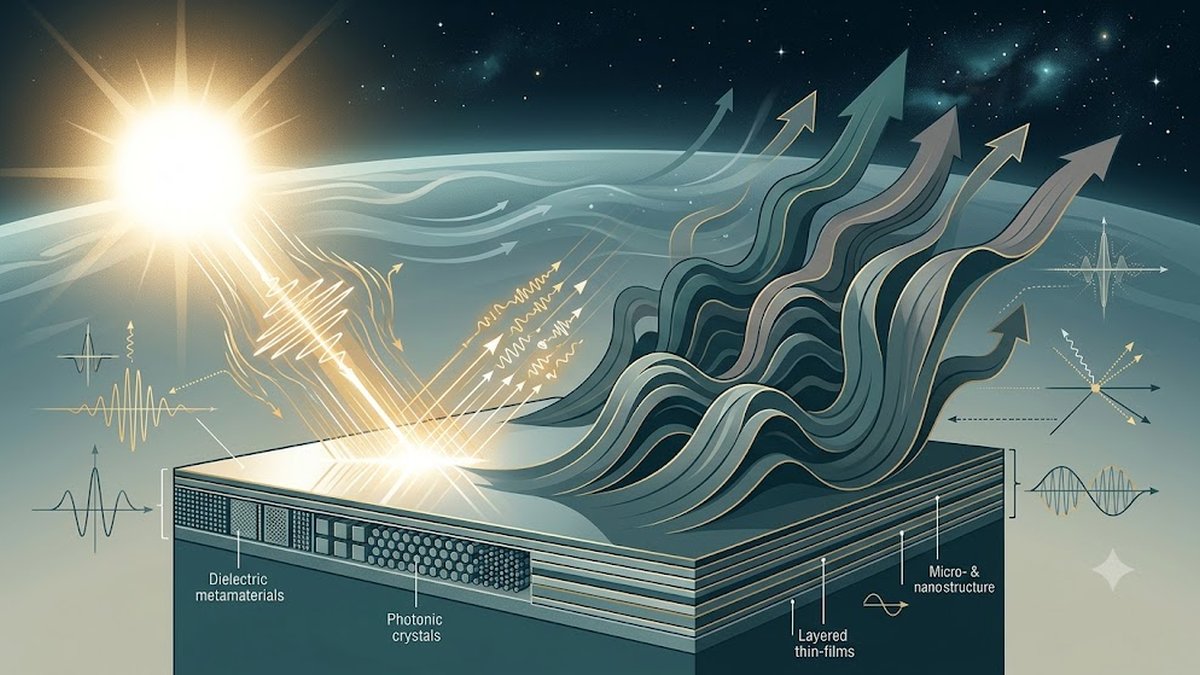
Cooling buildings, electronic systems, industrial equipment, and other environments traditionally requires mechanical refrigeration or electrically powered air-conditioning. These technologies are effective, but they consume significant energy and can contribute to peak electricity demand and environmental impacts.
Passive radiative cooling offers a fundamentally different approach. Instead of using electricity to move heat from one location to another, specially engineered surfaces can emit thermal radiation through the atmosphere toward the cold upper atmosphere and, ultimately, the coldness of outer space.
The concept is rooted in fundamental physics: all objects above absolute zero emit electromagnetic radiation. By controlling how a surface absorbs and emits radiation, researchers can design materials that lose more thermal energy than they receive from their surroundings under suitable conditions.
This makes passive radiative cooling an important research area at the intersection of thermal physics, materials science, photonics, nanotechnology, and sustainable engineering.
What Is Passive Radiative Cooling?
Passive radiative cooling is a method of reducing the temperature of an object or surface by allowing it to emit thermal energy as electromagnetic radiation without requiring an electrically powered refrigeration cycle.
The key mechanism is thermal radiation.
Every object with a temperature above absolute zero emits electromagnetic radiation. The wavelength distribution of this radiation depends strongly on temperature. At temperatures commonly encountered on Earth, a substantial portion of thermal emission occurs in the infrared region.
A radiative cooling surface is engineered to:
- Emit thermal radiation efficiently
- Reflect a large portion of incoming solar radiation
- Minimize unwanted heat absorption
- Radiate energy through an atmospheric transmission window
- Exchange heat with the cold sky
Under appropriate environmental conditions, these properties can allow a surface to cool below the surrounding ambient temperature.
The Physics Behind Radiative Cooling
The physical basis of radiative cooling is closely related to the principles of thermal radiation.
The total thermal radiation emitted by an ideal blackbody is described by the Stefan–Boltzmann law:
$$P = \sigma A T^4$$
where:
- $P$ is the radiated power
- $\sigma$ is the Stefan–Boltzmann constant
- $A$ is the emitting area
- $T$ is the absolute temperature in kelvin
Real materials are not perfect blackbodies. Their ability to emit radiation depends on their emissivity, which varies with wavelength and direction.
A simplified expression for thermal emission can therefore be written as:
$$P = \varepsilon \sigma A T^4$$
where $\varepsilon$ represents emissivity.
However, designing an effective radiative cooling surface requires more than simply maximizing emissivity across all wavelengths. The material must also minimize the amount of solar energy absorbed during the day.
Why the Sky Can Act Like a Heat Sink
The central idea behind radiative cooling becomes clearer when considering the temperature of the sky.
The atmosphere is not equally transparent at every infrared wavelength. Certain wavelength ranges experience relatively strong atmospheric absorption, while another important region around 8–13 micrometers provides an atmospheric transmission window under suitable conditions.
Radiation emitted through this window can travel more effectively through the atmosphere toward the colder upper atmosphere and space.
This creates a remarkable physical situation: a surface on Earth can exchange thermal radiation with an effective radiative environment that is much colder than the surrounding air.
Editorial Insight: Passive radiative cooling does not literally "send heat directly into empty space" at every wavelength. Its effectiveness depends on atmospheric transparency, surface temperature, humidity, cloud conditions, and the spectral properties of the cooling material.
Daytime and Nighttime Radiative Cooling
Radiative cooling can occur both during the day and at night, but daytime operation is considerably more challenging.
At night, a cooling surface primarily needs to emit thermal radiation efficiently while minimizing unwanted heat exchange with its surroundings. During the daytime, the surface receives substantial solar radiation.
This creates a fundamental design requirement:
The surface must emit strongly in the thermal infrared while reflecting strongly across the solar spectrum.
| Property | Desired Characteristic | Purpose |
|---|---|---|
| Solar reflectance | Very high | Minimize solar heating |
| Thermal emissivity | High in selected infrared wavelengths | Maximize heat radiation |
| Atmospheric transmission | High in useful spectral region | Improve radiative heat escape |
| Visible appearance | Application-dependent | Balance aesthetics and optical performance |
| Thermal conductivity | Application-dependent | Control heat transfer within the system |
| Durability | High | Maintain performance over time |
| Manufacturing cost | Low or scalable | Support practical deployment |
This combination of optical properties is one of the central challenges in radiative cooling research.
How Advanced Materials Enable Cooling
Modern radiative cooling research relies heavily on engineered materials and structures.
Researchers investigate materials such as:
- Polymeric films
- Photonic structures
- Multilayer optical coatings
- Nanoparticle composites
- Dielectric materials
- Metamaterial-inspired structures
- Porous materials
- Nanostructured surfaces
The goal is not simply to create a material that is highly reflective or highly emissive. Instead, researchers seek to control the spectral and angular behavior of electromagnetic radiation.
Spectral Selectivity
A surface may be engineered to strongly reflect incoming sunlight while simultaneously emitting thermal radiation within selected infrared wavelengths. This selective behavior can be achieved through material composition, surface geometry, multilayer structures, particle scattering, or nanoscale design.
Photonic Engineering
Photonic structures can manipulate electromagnetic waves at specific wavelengths. By designing the dimensions and refractive properties of these structures, researchers can influence how radiation is reflected, transmitted, or emitted. This provides a powerful route for developing advanced radiative cooling materials.
A Simple Energy-Balance View
A useful way to understand radiative cooling is through an energy balance. A cooling surface receives energy from several sources and loses energy through several mechanisms.
A simplified balance can be represented as:
$$Q_{\text{net}} = Q_{\text{radiated}} - Q_{\text{atmospheric}} - Q_{\text{solar}} - Q_{\text{convection}} - Q_{\text{conduction}}$$
The exact formulation depends on the system and experimental conditions. For effective cooling, the net radiative heat loss must overcome the heat gained from sunlight, atmospheric radiation, convection, conduction, and other environmental sources. This explains why radiative cooling performance cannot be evaluated using emissivity alone.
Applications of Passive Radiative Cooling
Passive radiative cooling has potential applications across several sectors:
Building Cooling
Buildings are one of the most discussed applications. Radiative cooling surfaces can potentially be incorporated into:
- Roof coatings
- Building envelopes
- Cooling panels
- Rooftop systems
- Thermal insulation structures
Reducing the temperature of a roof or exterior surface can reduce heat transfer into a building. Radiative cooling may therefore complement conventional air-conditioning rather than completely replace it.
Solar Energy Systems
Photovoltaic systems become less efficient as operating temperatures increase. Radiative cooling structures may provide a passive method for reducing panel temperature under suitable conditions, creating an important research intersection between renewable energy and thermal management.
Electronics and Data Centers
Electronic devices generate heat continuously. Passive thermal management approaches can potentially help reduce the cooling burden for:
- Electronic components
- Sensors
- Outdoor communication equipment
- Battery systems
- Data-center infrastructure
The practical feasibility depends heavily on environmental conditions and the thermal pathway between the device and the radiative surface.
Cold-Chain and Food Systems
Radiative cooling may also have applications where maintaining lower temperatures is important for food preservation and agricultural transport, complementing other low-energy thermal management techniques.
What Makes Daytime Cooling Difficult?
The biggest challenge for daytime radiative cooling is solar irradiance. Solar radiation reaching Earth's surface can reach hundreds of watts per square meter under direct sunlight.
A cooling material must reject a substantial amount of solar energy while simultaneously emitting infrared radiation. This creates a competition between two optical requirements:
- Reflect sunlight: Absorb as little solar energy as possible across UV, visible, and near-IR bands.
- Emit thermal radiation: Release heat efficiently through the 8–13 $\mu\text{m}$ atmospheric window.
Environmental Conditions Matter
Radiative cooling is strongly influenced by atmospheric conditions:
- Humidity: Water vapor absorbs infrared radiation at several wavelengths. High atmospheric humidity noticeably reduces the effective cooling power.
- Clouds: Cloud cover alters the downwelling infrared radiation field, significantly reducing the transparency of the atmospheric window.
- Wind and Convection: Even when a surface radiates heat effectively, convective air currents transfer heat back into the surface, damping the net cooling effect.
- Geographic Location: Performance varies with climate, latitude, altitude, and seasonal weather patterns. A material validated in an arid environment may yield lower sub-ambient cooling in a tropical zone.
Challenges in Radiative Cooling Research
Although passive radiative cooling is scientifically promising, several practical challenges remain:
- Maintaining Daytime Performance: Achieving near-unity solar reflectance (>95%) while maximizing mid-infrared emissivity is technically demanding.
- Material Durability: Outdoor materials must withstand ultraviolet radiation, dust deposition, rain, thermal cycling, and mechanical abrasion.
- Optical Degradation: Soiling and surface weathering can drastically increase solar absorption over time.
- Manufacturing Scalability: Complex photonic crystals and metamaterials fabricated at laboratory scales are often cost-prohibitive for large-area deployment.
- Real-World Standardized Testing: Outdoor environments fluctuate constantly, necessitating standardized reporting frameworks for fair comparisons.
How to Design a Strong Research Study
Researchers investigating passive radiative cooling should move beyond reporting only a surface temperature. A robust study must evaluate comprehensive performance indicators.
Recommended Measurements
- Solar Reflectance: Quantify total and spectral hemispherical reflectance across $0.3\text{--}2.5,\mu\text{m}$.
- Spectral Emissivity: Characterize infrared emission across the mid-infrared range ($2.5\text{--}20,\mu\text{m}$), specifically within the $8\text{--}13,\mu\text{m}$ window.
- Net Cooling Power: Determine net heat loss ($\text{W/m}^2$) as a function of surface temperature under steady-state conditions.
- Sub-Ambient Temperature Drop: Measure surface temperature relative to ambient air with appropriate parasitic heat shields.
- Environmental Metadata: Continuously log ambient temperature, relative humidity, wind speed, global horizontal irradiance (GHI), and cloud cover.
- Accelerated Weathering: Assess optical retention after UV exposure, thermal cycling, and dirt accumulation.
- Baseline Comparison: Benchmark against standard cool-roof coatings, commercial white paint, or bare substrate materials.
Pro Tip: A convincing radiative-cooling study should report optical properties and environmental conditions alongside temperature measurements. A single temperature value is rarely sufficient to establish the performance of a new cooling material.
Good vs. Weak Research Examples
Weak Research Question
"Can radiative cooling reduce temperature?"
This question is too broad and lacks quantifiable parameters or physical boundary conditions.
Stronger Research Question
"How does the solar reflectance and mid-infrared emissivity of a polymer-based radiative cooling coating influence daytime sub-ambient cooling under humid outdoor conditions?"
The stronger question explicitly defines:
- Material system
- Optical mechanisms
- Environmental regime
- Measurable response variables
Similarly, reporting "The surface became 5°C cooler" lacks rigorous utility without stating ambient air temperature, wind velocity, net solar irradiance, relative humidity, and the baseline reference used.
Research Opportunities for Physicists and PhD Scholars
Passive radiative cooling provides rich ground for interdisciplinary investigation:
- Nanophotonic and hierarchical porous cooling surfaces
- Scalable, paint-format polymer and nanoparticle composites
- Radiative cooling films for photovoltaic efficiency enhancement
- Self-adaptive or switchable radiative materials (e.g., phase-transition materials like $\text{VO}_2$ for winter/summer modulation)
- High-humidity optimization and localized convective shielding
- AI-driven photonic inverse design and spectral optimization
- Hybrid systems coupling radiative cooling with phase-change thermal storage
The Future of Passive Cooling
The future of radiative cooling lies in multifunctional, scalable materials that balance optical performance with mechanical longevity. Rather than operating in isolation, passive radiative cooling is emerging as a critical component of hybridized energy systems—integrating with building envelopes, cold storage, and heat sinks to slash global HVAC electrical loads.
Actionable Pre-Submission Checklist
Before submitting a radiative cooling manuscript, verify:
- Research Problem: Is the objective focused, hypotheses-driven, and experimentally testable?
- Literature Positioning: Does the paper clearly articulate its novelty relative to state-of-the-art benchmarks?
- Material Characterization: Are morphological, chemical, and structural properties thoroughly detailed?
- Solar Performance: Is solar reflectance ($\rho_{\text{solar}}$) measured across the relevant spectral band?
- Thermal Emission: Is spectral emissivity ($\varepsilon_{\text{LWIR}}$) verified across the atmospheric window?
- Environmental Context: Are solar irradiance, relative humidity, ambient temperature, and wind speed logged?
- Energy Balance: Are convection and conduction losses accounted for in net power calculations?
- Controlled Baselines: Is performance benchmarked against recognized standards or control samples?
- Reproducibility: Are fabrication steps, chemical formulations, and instrumentation setups described with precision?
- Durability & Longevity: Are stability data (UV aging, mechanical adhesion, hydrophobicity) addressed?