
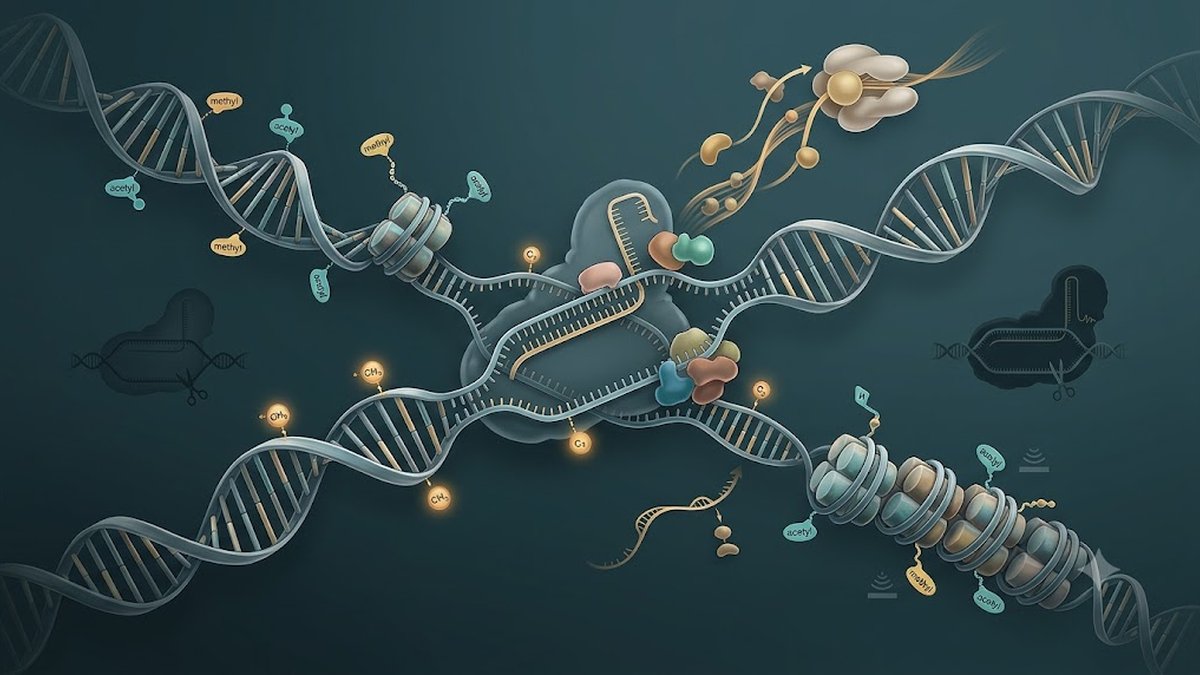
CRISPR technology has transformed modern molecular biology by giving researchers an unprecedented ability to target specific sequences in the genome. However, conventional CRISPR-Cas9 genome editing often relies on creating a DNA double-strand break and allowing cellular repair mechanisms to modify the targeted sequence.
A newer direction is asking a different question: What if disease-associated gene activity could be changed without permanently rewriting the DNA sequence?
This concept is at the heart of CRISPR 2.0 and epigenome editing. Instead of cutting DNA, researchers can use programmable molecular systems to influence whether selected genes are active or silent. The objective is not necessarily to change the genetic code, but to modify the regulatory state surrounding it.
This distinction could become important for diseases in which abnormal gene expression, rather than a single defective DNA sequence, contributes to pathology.
What Is Epigenome Editing?
The epigenome is the collection of molecular modifications and regulatory structures that influence how genes are expressed without changing the underlying DNA sequence.
Several mechanisms participate in this regulation, including:
- DNA methylation: Chemical modification of DNA that can influence whether genes are transcribed.
- Histone modifications: Changes to proteins around which DNA is packaged, affecting chromatin accessibility.
- Chromatin remodeling: Structural changes that determine how accessible particular genomic regions are.
- Transcriptional regulation: Molecular processes that increase or decrease the production of RNA from genes.
Epigenome editing attempts to manipulate these regulatory mechanisms at a selected genomic location.
Instead of using Cas9 primarily as a molecular scissors, researchers can use a catalytically inactive form known as dCas9. This protein can still be guided to a target DNA sequence by an RNA molecule, but it does not cut the DNA.
The dCas9 platform can then be coupled to an effector protein that activates, represses, methylates, demethylates, or otherwise modifies the local regulatory environment.
Editorial Insight: The fundamental shift is from "change the DNA sequence" to "change how the existing DNA is interpreted." This distinction makes epigenome editing a powerful research platform for diseases driven by abnormal gene regulation.
CRISPR 1.0 vs. CRISPR 2.0
The term "CRISPR 2.0" is best understood as a broad description of next-generation CRISPR approaches rather than a single standardized technology.
A simplified comparison illustrates the difference:
| Feature | Conventional CRISPR-Cas9 | Epigenome Editing / CRISPR 2.0 |
|---|---|---|
| Primary objective | Modify DNA sequence | Modify gene activity |
| Typical protein | Active Cas9 | dCas9 or related programmable DNA-binding system |
| DNA double-strand break | Often used | Generally avoided |
| Genetic sequence | Can be permanently altered | Usually remains unchanged |
| Main mechanism | DNA cleavage and repair | Transcriptional or epigenetic regulation |
| Examples | Gene knockout, sequence correction | CRISPRi, CRISPRa, methylation editing |
| Potential reversibility | Often limited after permanent editing | Can potentially be reversible depending on system |
| Main research value | Correct or disrupt genetic sequences | Tune gene expression and cellular states |
This does not mean epigenome editing is automatically safer or more effective. It represents a different therapeutic strategy with its own biological and technical risks.
How Does CRISPR-Based Epigenome Editing Work?
A typical epigenome-editing system contains three conceptual components:
1. Targeting Module
A guide RNA directs the CRISPR-associated protein toward a selected DNA sequence.
The guide RNA provides the targeting specificity that makes CRISPR systems programmable.
2. DNA-Binding Platform
Instead of using an active nuclease to cut DNA, researchers can employ dCas9, which retains DNA-targeting capability while lacking normal cutting activity.
This creates a programmable molecular anchor at the desired genomic region.
3. Epigenetic Effector
The DNA-binding platform can be connected to an effector domain that changes the regulatory state of the targeted region.
Depending on the design, researchers can recruit proteins associated with:
- Gene activation
- Gene repression
- DNA methylation
- DNA demethylation
- Histone modification
- Chromatin remodeling
The result is targeted regulation rather than conventional sequence disruption.
CRISPRi and CRISPRa: Controlling Gene Activity
Two important examples are CRISPR interference (CRISPRi) and CRISPR activation (CRISPRa).
CRISPRi: Turning Down Gene Expression
CRISPRi uses a catalytically inactive CRISPR protein to interfere with transcription.
Depending on the system, repression can occur through steric interference with transcription machinery or recruitment of transcriptional repressor domains.
For example, if excessive expression of a particular gene contributes to disease, CRISPRi could theoretically be used to reduce its activity without deleting the gene.
CRISPRa: Increasing Gene Expression
CRISPRa takes the opposite approach.
Instead of suppressing transcription, the system recruits transcriptional activators to a selected regulatory region.
This could be useful when a protective or therapeutic gene is present in the genome but expressed at insufficient levels.
The important concept is gene dosage control: rather than treating genes as simply "on" or "off," epigenome editing may eventually allow researchers to tune expression levels more precisely.
Why Avoiding DNA Double-Strand Breaks Matters
DNA double-strand breaks are powerful tools for genome engineering, but they also introduce biological consequences.
After a DNA break, the cell must repair the damaged chromosome. Repair can produce intended modifications, but it can also generate unintended sequence changes or structural outcomes.
Epigenome editing approaches seek to avoid this particular mechanism by regulating gene expression without intentionally creating a double-strand break.
Potential advantages include:
- Reduced dependence on DNA repair pathways
- Avoidance of intentional double-strand DNA cleavage
- Ability to regulate rather than delete genes
- Potential reversibility of some regulatory changes
- Possibility of fine-tuning gene expression
- New strategies for diseases involving abnormal gene regulation
However, avoiding DNA breaks does not eliminate every safety concern. Targeting accuracy, unintended regulatory effects, delivery, immune responses, durability, and long-term biological consequences remain important research questions.
Where Could Epigenome Editing Be Used?
Epigenome editing is being investigated across several areas of biomedical research.
Cancer
Cancer cells frequently exhibit abnormal patterns of gene regulation.
Some tumor-suppressor genes may become transcriptionally silenced, while genes supporting proliferation or survival may become abnormally active.
An epigenome-editing strategy could theoretically attempt to restore a more appropriate regulatory state.
For example, rather than deleting an oncogenic region, researchers may investigate whether its expression can be selectively reduced.
Neurological and Neurodegenerative Disorders
The nervous system presents a particularly interesting application because many neurological conditions involve complex changes in gene expression.
Programmable transcriptional regulation could potentially influence genes associated with neuronal survival, inflammation, synaptic function, or disease progression.
The major challenge is delivery: reaching the appropriate cells in the brain while maintaining adequate specificity remains technically difficult.
Genetic Disorders
Not every genetic disease requires correction of the exact DNA sequence.
Some disorders involve abnormal gene dosage, regulatory dysfunction, or epigenetic mechanisms. In such cases, controlling expression from an existing genomic sequence could represent an alternative therapeutic strategy.
Rare and Complex Diseases
Traditional gene replacement approaches can be challenging when diseases involve multiple genes or regulatory networks.
Epigenome editing offers the possibility of targeting specific regulatory nodes rather than permanently modifying numerous DNA sequences.
This remains an active research area rather than a universally established clinical solution.
Real-World Research Example: Gene Regulation Instead of Gene Deletion
Consider a hypothetical disease in which Gene X produces a protein that becomes harmful when excessively expressed.
A conventional knockout strategy might attempt to disrupt Gene X at the DNA level.
That approach could permanently prevent the gene from functioning.
An epigenome-editing strategy could instead use CRISPRi to reduce Gene X transcription.
The conceptual difference is:
Conventional editing:
Gene X → DNA sequence disrupted → Gene X function reduced or eliminated
Epigenome editing:
Gene X → regulatory state modified → Gene X expression reduced
This distinction could be particularly valuable when complete gene loss would create a different biological problem.
Good vs. Bad Therapeutic Framing
Less precise claim:
"CRISPR 2.0 can cure genetic diseases without risks."
This statement overstates the current evidence.
More scientifically appropriate statement:
"CRISPR-based epigenome editing is being investigated as a programmable method for regulating disease-associated gene expression without intentionally introducing DNA double-strand breaks."
The second formulation distinguishes scientific potential from established clinical outcomes.
Major Advantages and Remaining Challenges
The promise of epigenome editing should be considered alongside its limitations.
| Potential Advantage | Scientific Challenge |
|---|---|
| No intentional DNA double-strand break | Off-target regulatory activity |
| Programmable gene regulation | Efficient delivery to target tissues |
| Potentially reversible regulation | Durability can vary by cell type |
| Can activate or repress genes | Complex chromatin environments |
| May fine-tune expression | Precise dose-response relationships |
| Useful for functional genomics | Long-term biological effects |
| Potential applications in complex disease | Translation from models to humans |
A particularly important issue is that epigenetic regulation is context-dependent.
The same regulatory modification may behave differently depending on cell type, developmental state, chromatin environment, and surrounding regulatory elements.
Therefore, a successful result in cultured cells does not automatically establish therapeutic effectiveness in patients.
Is Epigenome Editing Truly Reversible?
One of the most attractive concepts in epigenome editing is reversibility.
Because the underlying DNA sequence may remain unchanged, researchers can potentially remove or alter the regulatory intervention and allow gene expression to change again.
However, "potentially reversible" should not be confused with "always reversible."
Some epigenetic states can persist after the original editing machinery is removed. Cellular memory, chromatin architecture, DNA methylation patterns, and feedback mechanisms can influence how long an effect lasts.
For therapeutic development, researchers therefore need to determine not only whether a gene can be regulated, but also:
- How long the effect persists
- Whether the effect can be reversed
- Whether repeated treatment is possible
- Whether unintended genes are affected
- Whether cellular identity changes over time
The Delivery Problem
One of the largest barriers to therapeutic gene and epigenome editing is not simply designing the editor—it is getting the right molecular components into the right cells.
Potential delivery approaches include viral vectors, lipid-based nanoparticles, engineered particles, and other emerging systems.
Different tissues create different delivery requirements.
For example, a liver-directed therapy may have very different delivery characteristics from a treatment intended for skeletal muscle or the central nervous system.
The ideal system must achieve sufficient delivery while limiting exposure to non-target cells.
Epigenome Editing vs. Base and Prime Editing
Epigenome editing should also be distinguished from base editing and prime editing.
Base and prime editors are designed to make specific changes to DNA sequences without relying on conventional double-strand breaks in the same way as standard Cas9 editing.
Epigenome editing takes a different approach: it primarily changes gene regulation while seeking to preserve the underlying DNA sequence.
This creates a broader toolkit in which researchers can choose between:
- Sequence disruption
- Precise nucleotide modification
- DNA sequence rewriting
- Gene activation
- Gene repression
- Epigenetic reprogramming
The future of genome engineering may therefore involve selecting the least disruptive intervention capable of producing the desired biological effect.
What Could CRISPR 2.0 Mean for Precision Medicine?
Precision medicine aims to match treatment strategies to the molecular characteristics of individual diseases.
Epigenome editing fits naturally into this concept because researchers can potentially design regulatory interventions around specific disease-associated expression patterns.
Instead of asking only:
"Which mutation causes the disease?"
future therapeutic research may increasingly ask:
"Which gene-regulatory state is causing the abnormal phenotype, and can that state be precisely changed?"
This could be particularly relevant for diseases involving networks of genes rather than a single pathogenic mutation.
Nevertheless, therapeutic development requires rigorous validation of efficacy, specificity, delivery, durability, toxicity, and long-term outcomes before experimental approaches can become established treatments.
The Future of CRISPR 2.0
The evolution of CRISPR technology is increasingly expanding beyond the idea of molecular scissors.
The next generation of programmable biological tools may allow scientists to manipulate when, where, and how strongly genes are expressed while leaving the underlying DNA sequence intact.
Epigenome editing is especially interesting because it combines the targeting capabilities of CRISPR with the regulatory complexity of the epigenome.
Its future will depend on solving several fundamental problems: improving targeting precision, controlling the duration of effects, developing tissue-specific delivery systems, understanding long-term consequences, and demonstrating meaningful therapeutic benefits in rigorous clinical studies.
For now, CRISPR 2.0 should be viewed as an important and rapidly developing research direction—not as a universal replacement for conventional genome editing.
Key Takeaways for Researchers
- CRISPR 2.0 is a broad concept encompassing next-generation CRISPR-based regulatory technologies.
- Epigenome editing can modify gene activity without intentionally cutting DNA.
- dCas9 provides programmable DNA targeting without conventional nuclease activity.
- CRISPRi can repress gene expression, while CRISPRa can activate it.
- DNA methylation and histone modifications are important targets for epigenetic regulation.
- Avoiding double-strand breaks may address some risks associated with conventional genome editing, but it does not eliminate safety concerns.
- Delivery, specificity, durability, reversibility, and long-term effects remain major research challenges.
- Clinical translation requires substantially more evidence than successful laboratory gene regulation.
Pre-Submission Checklist
Before submitting research or a scholarly article related to CRISPR epigenome editing, verify the following:
- Define the editing technology clearly: Distinguish epigenome editing from conventional Cas9 editing, base editing, and prime editing.
- Identify the biological mechanism: Explain whether the intervention involves transcriptional repression, activation, DNA methylation, histone modification, or another mechanism.
- Avoid overclaiming: Do not describe an experimental approach as a proven cure without appropriate clinical evidence.
- Report the model system: Clearly identify whether findings come from cell culture, organoids, animal models, or human studies.
- Assess specificity: Describe available evidence regarding on-target and off-target effects.
- Discuss delivery: Explain how the editing machinery reaches the intended cells or tissue.
- Address durability: Report whether gene-regulatory effects persist after the editing system is removed.
- Consider reversibility: Distinguish demonstrated reversibility from theoretical reversibility.
- Document limitations: Include technical, biological, translational, and safety limitations.
- Use current scholarly literature: Support major claims with recent peer-reviewed studies and authoritative reviews.
- Separate evidence from expectation: Clearly distinguish established findings, preclinical observations, and future therapeutic possibilities.
- Check terminology: Use CRISPR, dCas9, CRISPRi, CRISPRa, epigenome editing, and related terms consistently throughout the manuscript.
The central promise of CRISPR 2.0 is not simply to edit genes more efficiently. It is to make biological regulation increasingly programmable—potentially allowing researchers to adjust disease-associated gene activity while preserving the underlying genetic sequence. As the technology develops, the key scientific question will be not merely what can be edited, but how precisely gene regulation can be controlled, for how long, and with what measurable therapeutic benefit.