
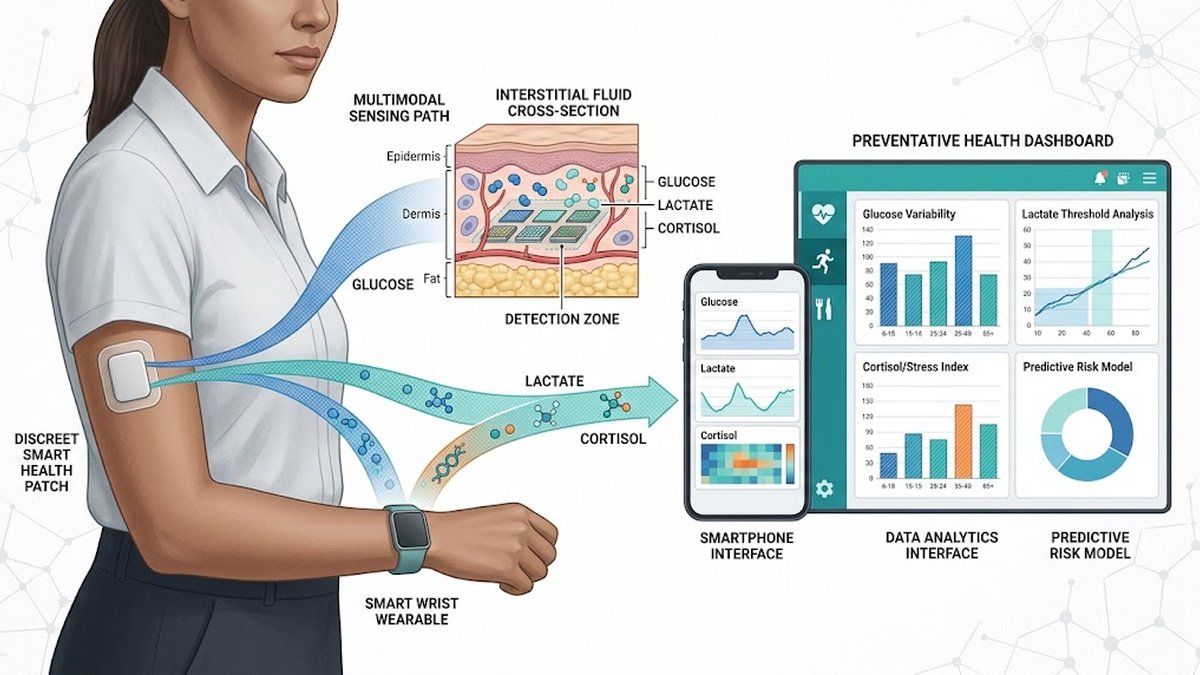
Healthcare has traditionally relied on periodic measurements: a blood test during a clinical visit, a glucose reading after symptoms appear, or a laboratory assessment when a physician needs diagnostic evidence. Although this model remains essential, it provides only snapshots of a biological system that is continuously changing.
Continuous biomarker wearables represent a different approach. Instead of observing physiology only during scheduled appointments, wearable biosensors aim to collect biochemical information repeatedly—or continuously—from accessible biological fluids such as interstitial fluid and sweat.
This shift could complement conventional medicine by revealing patterns that isolated measurements may miss. Continuous glucose monitoring already demonstrates the clinical value of measuring a biochemical variable through interstitial fluid, while wearable sweat sensors for lactate, cortisol, glucose, electrolytes, and related biomarkers remain an active research area.
The emerging research question is therefore not simply whether a wearable can detect a biomarker. It is whether the resulting longitudinal data can be validated, interpreted, and translated into clinically meaningful decisions.
From Periodic Testing to Continuous Monitoring
Traditional laboratory diagnostics generally involve a defined sample collected at a particular moment. The result can be highly accurate, but it represents the patient's physiological state at that time.
Wearable biosensors introduce another dimension: time-series biological information.
A sensor positioned on or near the skin can potentially measure biochemical changes while a person sleeps, exercises, works, eats, or experiences stress. Depending on the technology, measurements may be collected from sweat, interstitial fluid, saliva, tears, or other biological matrices.
This creates an opportunity to study:
- Temporal changes: How a biomarker changes throughout the day.
- Responses to events: How biomarkers respond to exercise, meals, sleep, or stress.
- Individual patterns: What constitutes a person's usual physiological range.
- Early deviations: Whether sustained changes appear before conventional symptoms or clinical measurements.
- Intervention responses: How lifestyle or therapeutic interventions influence biological signals over time.
The concept is important because prevention depends not only on identifying abnormal values but also on understanding trajectories and patterns.
How Continuous Biomarker Wearables Work
A wearable biochemical monitoring system generally combines several technological layers.
1. Biological sampling
The first challenge is obtaining a suitable biological fluid. Sweat is attractive because it can be collected non-invasively from the skin, whereas interstitial fluid can provide information closely associated with the body's extracellular environment.
Sweat contains metabolites, electrolytes, and other biological compounds, making it a promising medium for wearable biochemical analysis.
2. Biosensing
The sensor recognizes the target molecule and converts its interaction into a measurable signal.
Common approaches include:
- Amperometric sensing: Measures electrical current associated with biochemical reactions.
- Potentiometric sensing: Detects changes in electrical potential.
- Colorimetric sensing: Produces a measurable optical or visual response.
- Electrochemical sensing: Uses chemical interactions to generate electrical signals.
Recent reviews describe electrochemical approaches as particularly important for wearable sweat-biomarker monitoring, although interference and calibration remain significant challenges.
3. Signal processing and communication
Raw sensor signals are not automatically clinical measurements. Algorithms may be required to compensate for temperature, motion, sensor drift, environmental conditions, and other sources of variability.
The processed information can then be transmitted to a smartphone, wearable receiver, or cloud-based analytics platform.
4. Interpretation
The final layer is arguably the most important.
A wearable can report a number, but healthcare requires context.
A meaningful system should help determine whether a change is:
- normal physiological variation,
- measurement noise,
- an exercise-related response,
- a persistent biological change,
- or a signal requiring professional evaluation.
Key Biomarkers Under Investigation
Different biomarkers provide different types of physiological information. Their measurement technologies and levels of clinical validation also vary considerably.
| Biomarker | Potential Sample | What It May Indicate | Wearable Research Status |
|---|---|---|---|
| Glucose | Interstitial fluid, sweat | Glucose regulation and metabolic patterns | Clinically established for interstitial glucose monitoring; non-invasive sweat approaches remain investigational |
| Lactate | Sweat | Exercise metabolism and physiological response | Active research; correlation with blood lactate remains complex |
| Cortisol | Sweat and other biofluids | Stress-related physiological response | Promising research area, but real-world validation remains limited |
| Electrolytes | Sweat | Hydration and electrolyte balance | Extensive wearable research, especially in sports science |
| pH | Sweat | Local biochemical and physiological changes | Common target in experimental wearable systems |
The distinction between commercial availability, research validation, and clinical utility is critical. A sensor demonstrating successful detection in a laboratory does not automatically become a diagnostic device.
Continuous Glucose Monitoring: A More Mature Example
Among biochemical wearables, continuous glucose monitoring (CGM) provides one of the clearest examples of how continuous sensing can become part of healthcare.
FDA documentation for systems such as Simplera describes measurement of glucose in interstitial fluid, with readings transmitted wirelessly to an application that can provide trends and alerts.
This model illustrates why continuous monitoring can be different from occasional testing.
Instead of asking only:
“What is the glucose value right now?”
a continuous system can provide information about:
- glucose trends,
- periods of rising or falling glucose,
- recurring patterns,
- responses to meals and physical activity,
- and episodes requiring attention.
Importantly, this does not mean every biomarker should automatically be monitored continuously. The clinical value depends on whether repeated measurements improve understanding or management of a specific health problem.
Lactate: From Laboratory Measurement to Wearable Sensing
Lactate is another important target for wearable biosensor research.
Traditional lactate testing often relies on blood sampling, particularly in sports physiology and exercise research. Wearable sweat sensors attempt to provide a less invasive alternative capable of tracking changes during physical activity.
Research has demonstrated substantial progress in continuous sweat-lactate sensing. However, researchers have also emphasized an important limitation: sweat lactate should not automatically be treated as equivalent to blood lactate.
The relationship can be affected by sweat rate, environmental conditions, exercise intensity, sampling location, and physiological lag.
Therefore, the research opportunity is not simply to make a smaller lactate sensor. Researchers must establish when sweat measurements accurately represent the physiological question being studied.
Cortisol and Continuous Stress Monitoring
Cortisol is another frequently investigated biomarker because it participates in the body's stress response.
Wearable sweat sensors have been developed to explore cortisol measurement during physical activity and other conditions. However, the evidence base is considerably less mature than established continuous glucose monitoring.
A systematic review of wearable sweat biomarkers identified lactate, cortisol, glucose, and electrolytes among the principal targets and concluded that sweat biomarkers can provide useful information about stress and fatigue, while emphasizing that these measurements often assess such states indirectly.
This distinction matters for academic researchers.
A wearable cortisol measurement should not automatically be interpreted as a direct measurement of psychological stress. Biological signals are influenced by multiple physiological and environmental factors.
Why Continuous Monitoring Could Change Preventive Healthcare
The major promise of biomarker wearables is the transition from episodic measurement to longitudinal observation.
Imagine a system capable of combining biochemical signals with heart rate, sleep, physical activity, temperature, and contextual information. Instead of analyzing a single measurement, researchers could study relationships across time.
For example:
Physical activity → lactate response → recovery pattern → sleep → subsequent physiological response
or:
Meal → glucose response → physical activity → overnight pattern → next-day measurements
Such datasets could support research into personalized physiological patterns and potentially identify deviations that warrant further clinical assessment.
However, continuous monitoring should be viewed as a decision-support and measurement technology, not as an autonomous replacement for medical diagnosis.
Editorial Insight: The most valuable wearable is not necessarily the device that measures the largest number of biomarkers. It is the system that produces reliable measurements, understands context, and connects those measurements to a clearly defined clinical or research question.
Major Challenges for Researchers
The field still faces substantial scientific and engineering challenges.
Sensor accuracy and calibration
Biological samples are complex. Temperature, pH, hydration, contamination, sweat rate, and other compounds can influence sensor performance.
Long-term wear introduces additional problems such as sensor drift and biofouling.
Biomarker correlation
A measurement from sweat or another accessible fluid may not perfectly correspond to the concentration of the same biomarker in blood or another reference matrix.
Researchers therefore need carefully designed correlation and validation studies.
Individual variability
Two people may produce substantially different biological signals under similar conditions.
Wearable algorithms should therefore be evaluated across:
- different ages,
- sexes,
- body compositions,
- activity levels,
- environmental conditions,
- and relevant clinical populations.
Motion and environmental artifacts
Wearables operate in the real world rather than controlled laboratories.
Movement, temperature, humidity, sweat rate, pressure, and sensor placement can influence measurements. Recent reviews specifically identify calibration, motion artifacts, inter-individual variability, and long-term stability as important barriers to practical deployment.
Data interpretation
Continuous monitoring can generate thousands of measurements.
More data does not automatically mean better healthcare.
Researchers need methods for identifying clinically meaningful patterns while minimizing false alarms and unnecessary interventions.
Research Opportunities for PhD Scholars and Academicians
The field offers opportunities across medicine, engineering, computer science, materials science, and data analytics.
Biosensor engineering
Researchers can investigate:
- flexible electrodes,
- nanomaterials,
- enzymatic sensing,
- microfluidic sampling,
- antifouling surfaces,
- and multi-analyte platforms.
Artificial intelligence and analytics
Machine learning can help model longitudinal biomarker data.
Potential research directions include:
- Personalized baseline modeling
- Anomaly detection
- Time-series forecasting
- Multimodal sensor fusion
- Context-aware biomarker interpretation
- Digital biomarkers and risk stratification
The objective should not be to apply AI simply because large datasets are available. A stronger research question asks whether an algorithm improves measurement interpretation, prediction, or clinical decision-making compared with established methods.
Clinical validation
Clinical and allied-health researchers can investigate whether wearable measurements correlate with established laboratory tests and whether continuous monitoring changes patient outcomes.
This requires carefully designed prospective studies rather than relying only on laboratory demonstrations.
A Practical Research Framework
Researchers planning a study in wearable biomarker monitoring can use the following sequence:
- Define the clinical or physiological question.
- Select a biomarker with a defensible biological rationale.
- Choose the appropriate sampling matrix.
- Identify a validated reference measurement.
- Design calibration and validation experiments.
- Evaluate environmental and motion-related effects.
- Measure inter-individual variability.
- Assess sensor stability over the intended wear period.
- Apply statistical and machine-learning methods only after establishing measurement quality.
- Evaluate whether the final system provides clinically meaningful information.
For PhD research, this framework can help transform a device-development project into a stronger translational research program.
The Future: From Single Biomarkers to Multimodal Health Profiles
The next generation of wearable systems is likely to move beyond individual biomarkers.
Researchers are exploring platforms capable of measuring multiple biochemical and physiological parameters together. Recent work on glucose biosensors, for example, discusses the possibility of combining measurements such as glucose, lactate, ketones, cortisol, and other analytes within integrated wearable systems.
The long-term vision is a multimodal physiological profile in which biochemical data are interpreted alongside:
- heart rate,
- sleep,
- physical activity,
- temperature,
- respiratory measures,
- nutrition,
- and environmental context.
Such systems could make preventive healthcare increasingly personalized.
Yet this future depends on evidence. Sensors must be analytically reliable, algorithms must be appropriately validated, and researchers must demonstrate that continuous measurements improve outcomes rather than merely increasing data volume.
Implications for Academic and Clinical Research
For academicians, continuous biomarker wearables represent more than a new category of consumer electronics.
They create a multidisciplinary research ecosystem connecting:
Biomedical engineering + clinical science + materials science + data science + digital health + preventive medicine
This creates opportunities for collaborative research, longitudinal cohort studies, clinical validation, digital biomarker discovery, and AI-assisted physiological modeling.
For journal authors, the strongest studies will clearly distinguish between:
- sensor feasibility,
- analytical validation,
- clinical validation,
- clinical utility,
- and patient outcomes.
These are different research questions and should not be treated as interchangeable.
Actionable Checklist for Researchers
Before submitting research on continuous biomarker wearables, verify the following:
- Define the biomarker and biological rationale clearly.
- Describe the sampling matrix and sensing mechanism.
- Compare measurements with an accepted reference method.
- Report calibration procedures and sensor drift.
- Evaluate motion, temperature, humidity, and other environmental effects.
- Report participant characteristics and inter-individual variability.
- Separate laboratory feasibility from clinical validation.
- Avoid claiming diagnostic capability without appropriate evidence.
- Explain how continuous measurements could affect clinical or research decisions.
- Use transparent statistical and machine-learning methodology.
- Discuss limitations, false positives, false negatives, and measurement uncertainty.
- Consider privacy, cybersecurity, consent, and responsible use of continuous health data.
Conclusion
Continuous biomarker wearables are helping expand the concept of health monitoring from occasional measurements toward longitudinal physiological observation.
Continuous glucose monitoring demonstrates that biochemical sensing can become clinically useful when the technology, validation, and clinical workflow are sufficiently mature. Meanwhile, sweat-based lactate, cortisol, glucose, and multi-analyte sensors continue to advance through research and engineering development.
The ultimate opportunity is not simply to place more sensors on the body. It is to transform continuous biological measurements into reliable, interpretable, and clinically meaningful information.
For researchers and academicians, the field offers a compelling intersection of biosensors, preventive healthcare, artificial intelligence, and personalized medicine. The next major advances will depend on rigorous validation, reproducible research, responsible data interpretation, and evidence that continuous monitoring can genuinely improve healthcare decisions.