
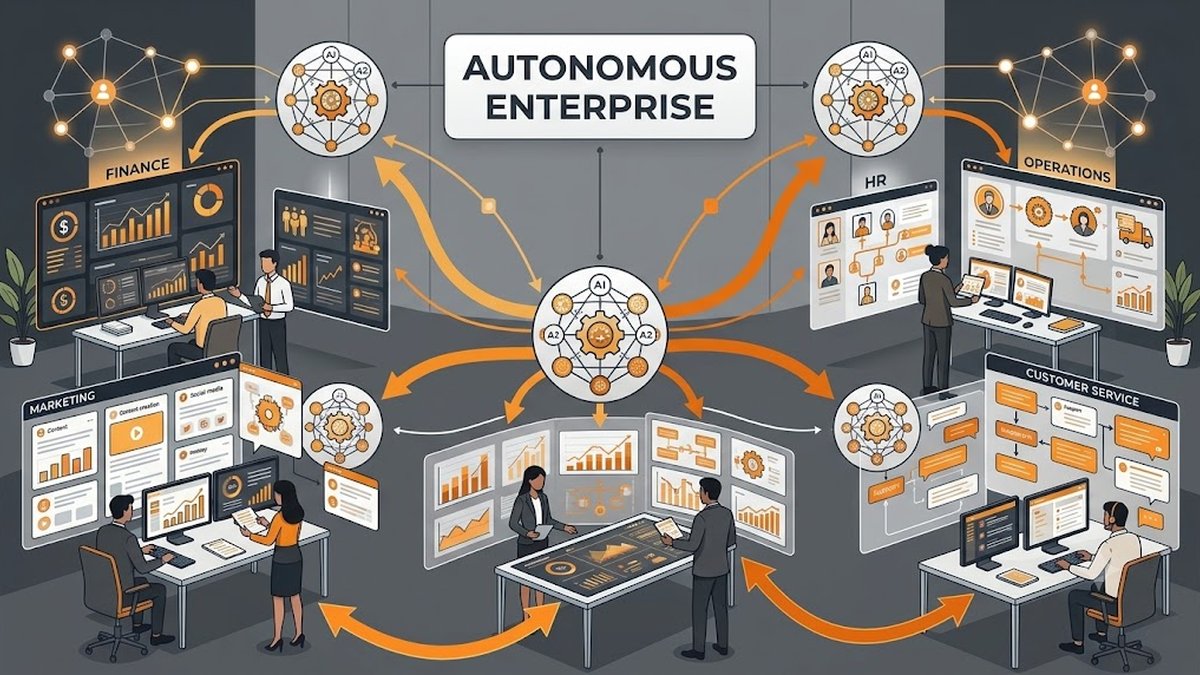
Introduction: From AI Assistance to AI Agents
Artificial intelligence is entering a new phase in which systems are moving beyond generating content or answering questions toward performing multi-step business tasks.
Agentic AI systems can be designed to interpret objectives, plan actions, use digital tools, retrieve information, and complete defined workflows with limited human intervention.
This development is creating a new management concept: the autonomous enterprise.
An autonomous enterprise does not mean an organization without employees. Instead, it describes an operating model in which humans and AI agents work together, with autonomous systems handling suitable digital workflows while employees focus on judgment, strategy, relationships, and exception management.
The key organizational question is therefore not whether AI will replace every job, but how work should be redesigned when individual tasks within a job can increasingly be performed by AI agents.
What Is an Autonomous Enterprise?
An autonomous enterprise integrates AI agents directly into business workflows.
Traditional automation generally follows predefined instructions:
Rule → Action → Result
Agentic AI introduces a more adaptive workflow:
Goal → Planning → Tool Use → Action → Evaluation → Next Action
For example, a conventional customer-service system may automatically categorize an incoming request.
An AI agent could potentially:
- Read the customer's request.
- Identify the issue.
- Retrieve relevant account information.
- Search approved knowledge sources.
- Prepare a response.
- Update the appropriate system.
- Escalate unusual cases to an employee.
This represents a transition from automating individual tasks to automating connected workflows.
How Agentic AI Changes Workforce Management
The most significant organizational impact may occur at the level of individual tasks.
Many knowledge-work jobs contain repetitive activities such as:
- collecting information,
- preparing reports,
- updating records,
- scheduling,
- document processing,
- data classification,
- routine communication.
AI agents may increasingly perform portions of these activities.
This can allow employees to spend more time on activities requiring:
- Strategic judgment
- Problem-solving
- Client relationships
- Negotiation
- Creative thinking
- Decision-making
- Exception handling
Consequently, workforce planning may gradually shift from asking “How many employees are required?” toward asking “What combination of employees, AI agents, and automation is required to complete the workflow?”
From Jobs to Human-AI Workflows
A useful way to understand this transition is to examine work at the task level.
| Traditional Work | Agentic AI Model |
|---|---|
| Employee collects information | AI agent retrieves information |
| Employee prepares first draft | AI agent prepares draft |
| Employee checks routine data | AI agent performs initial validation |
| Employee handles every request | AI agent handles routine cases |
| Manager monitors tasks | Manager monitors exceptions and outcomes |
| Employee performs repetitive workflow | Human supervises AI-enabled workflow |
This does not mean every task should be automated.
The appropriate level of autonomy depends on the risk, complexity, reversibility, and business consequences of the activity.
Which Business Tasks Are Suitable for AI Agents?
Agentic AI is particularly relevant to workflows that are structured, digital, repetitive, and measurable.
Suitable Examples
Document Processing
Agents can classify documents, extract information, check completeness, and route records.
Customer Support
Agents can handle routine inquiries and escalate complex cases.
Research
Agents can gather information from approved sources and prepare structured research summaries.
Sales Operations
Agents can qualify leads, update CRM records, and prepare follow-up activities.
Finance Operations
Agents can assist with invoice processing, reconciliation, and routine reporting.
Human Resources
Agents can support employee queries, document workflows, and administrative processes.
The objective should be to automate appropriate activities while maintaining human control over decisions with significant consequences.
The New Role of Managers
Agentic AI can also change what managers do.
Managers traditionally spend considerable time assigning tasks, monitoring progress, checking reports, and coordinating employees.
In an AI-enabled enterprise, some of this operational coordination may be handled by software agents.
Managers may instead spend more time on:
- defining business objectives,
- monitoring AI performance,
- managing exceptions,
- developing employees,
- reviewing risks,
- making strategic decisions,
- coordinating human and AI capabilities.
This creates a shift from task supervision to workflow and outcome management.
Human-in-the-Loop Governance
Autonomous systems require clearly defined boundaries.
A practical enterprise model is human-in-the-loop governance.
For low-risk activities, an AI agent may complete a workflow automatically.
For higher-risk activities, the agent can prepare the recommended action but require human approval.
For example:
AI Agent → Analyze supplier issue → Recommend action → Human approval → Execute
This model allows organizations to obtain automation benefits without removing human accountability.
When Should Humans Remain Involved?
Human review becomes particularly important when an AI action could involve:
- significant financial commitments,
- legal consequences,
- sensitive employee decisions,
- confidential information,
- irreversible actions,
- major customer impact.
The level of human involvement should therefore increase with the potential consequences of an error.
Agent Swarms and Multi-Agent Workflows
A further development is the use of multiple specialized AI agents.
Instead of asking one AI system to perform every task, organizations can create agents with different responsibilities.
For example:
Research Agent → Analysis Agent → Verification Agent → Reporting Agent → Human Manager
The research agent gathers information, the analysis agent interprets it, the verification agent checks important findings, and the reporting agent prepares the final output.
The human manager remains responsible for reviewing the result and making the strategic decision.
This model resembles a digital team in which each agent has a defined role.
Workforce Skills for the Agentic AI Economy
As AI performs more routine digital tasks, employee skills may need to evolve.
Technical skills can include:
- AI tool usage,
- workflow automation,
- data literacy,
- AI output evaluation,
- process design,
- basic AI governance.
Human capabilities remain equally important.
These include:
- critical thinking,
- communication,
- leadership,
- creativity,
- negotiation,
- domain expertise,
- ethical reasoning.
The emerging advantage may therefore come from employees who understand both the business process and how AI can be applied safely within that process.
Organizational Redesign
Simply introducing AI agents into existing workflows may not produce substantial transformation.
Organizations should first identify:
What work is being performed?
Then determine:
Which tasks require human judgment?
Which tasks can be assisted by AI?
Which tasks can be safely delegated to an agent?
Where should human approval remain mandatory?
This can produce a redesigned workflow such as:
Human defines objective → AI performs routine research → AI analyzes information → Human validates important findings → AI executes approved workflow
The organization is therefore redesigned around outcomes rather than individual task execution.
Pro Tip: Do not begin an agentic AI project by asking which AI model to deploy. Begin by mapping the workflow, identifying repetitive tasks, defining risk boundaries, and deciding where human judgment is essential.
Measuring the Business Impact
Organizations should evaluate agentic AI using measurable business outcomes rather than the number of AI agents deployed.
Useful metrics include:
- Workflow completion time
- Cost per transaction
- Error rate
- Human review time
- Customer response time
- Process throughput
- Exception rate
- Employee productivity
For example, an AI agent that completes 90% of routine customer requests may appear highly autonomous. However, if the remaining 10% create significant manual workload, the overall workflow may require further redesign.
The appropriate measure is therefore end-to-end business performance.
Key Risks for Organizations
Agentic AI introduces new operational risks alongside its potential benefits.
Incorrect Actions
An agent may misunderstand an instruction or act on inaccurate information.
Excessive Permissions
An agent connected to multiple enterprise systems may have access beyond what it actually requires.
Automation Bias
Employees may accept AI-generated recommendations without sufficient verification.
Accountability Gaps
Organizations must clearly identify who is responsible for an AI-enabled decision.
Coordination Problems
Multiple agents may produce conflicting actions if their roles and priorities are poorly defined.
These risks make AI governance part of workforce management, not merely an IT responsibility.
Research Opportunities for Academicians
The autonomous enterprise creates research opportunities across management and organizational studies.
Potential Research Areas
Human Resource Management
How should organizations redesign jobs when AI performs selected tasks?
Organizational Behavior
How does employee trust influence human-AI collaboration?
Strategic Management
How can AI-enabled operating models influence organizational competitiveness?
Operations Management
How does agentic AI affect process efficiency and workflow coordination?
Management Information Systems
What governance architectures are required for multi-agent enterprise systems?
Future of Work
Which employee skills become more valuable as routine digital work becomes increasingly automated?
These questions can support empirical research using employee surveys, organizational case studies, workflow experiments, and productivity data.
A Practical Implementation Framework
Organizations can approach agentic AI adoption through five focused steps.
1. Map the Workflow
Document the complete process rather than looking at isolated tasks.
2. Identify AI-Suitable Tasks
Select repetitive, digital, measurable, and relatively low-risk activities.
3. Define Human Boundaries
Specify when an agent can act independently and when approval is required.
4. Measure Results
Compare AI-enabled performance against the original workflow baseline.
5. Redesign Workforce Roles
Update responsibilities, training, performance measures, and accountability structures.
This approach allows organizations to increase autonomy gradually rather than attempting to automate entire departments at once.
The Future of the Autonomous Enterprise
The autonomous enterprise is likely to develop incrementally.
Organizations may progress from:
Automation → AI Assistance → Individual AI Agents → Multi-Agent Workflows → Greater Process Autonomy
Throughout this transition, human expertise remains important.
AI agents can potentially manage repetitive information flows and execute predefined actions at scale. Humans remain central to strategy, leadership, relationships, complex judgment, and accountability.
The most important organizational change may therefore be the emergence of hybrid workforces, where employees and AI agents perform complementary roles.
Actionable Checklist for Business Leaders
Before deploying an autonomous AI workflow, ask:
- Workflow: Is the complete process clearly mapped?
- Task: Which activities are repetitive and suitable for AI?
- Risk: What happens if the agent makes a mistake?
- Permissions: What systems and data can the agent access?
- Human oversight: When must an employee approve the action?
- Accountability: Who owns the final outcome?
- Measurement: Which business metrics will demonstrate value?
- Workforce: How will employee responsibilities change?
- Training: Do employees understand how to supervise AI?
- Governance: Can the organization's AI actions be monitored and audited?
Conclusion
Agentic AI is changing enterprise automation from individual task automation toward autonomous workflow management.
The emerging autonomous enterprise combines human employees with AI agents that can perform appropriate digital activities, coordinate information, and execute defined workflows.
For business leaders, the challenge is not simply deploying more AI. It is redesigning work intelligently.
Organizations need to determine which activities should remain human-led, which should be AI-assisted, and which can safely operate with greater autonomy.
For researchers and PhD scholars, this transition creates an important field of study connecting strategic management, human resource management, organizational behavior, operations, and artificial intelligence.
The central research question is increasingly becoming:
How can organizations design a workforce in which humans and autonomous AI agents work together efficiently, responsibly, and measurably?
Researcher's Quick Summary
Workflow mapping → AI task identification → human oversight → agent deployment → performance measurement → workforce redesign
The autonomous enterprise is ultimately not about removing humans from organizations. It is about redesigning how human expertise and increasingly capable AI systems work together to produce business outcomes.